
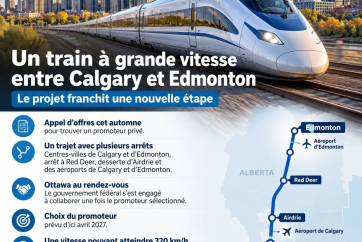
The high-speed rail project between Calgary and Edmonton has taken another important step forward. The Alberta government has confirmed that it will launch a competitive bidding process this fall to select a private partner to carry out one of the largest infrastructure projects in the province’s history.
The governments of Canada and Alberta announced this in a joint statement, confirming their commitment to working toward the creation of a modern high-speed rail line. The federal government will also join the project once the winner of the competitive selection process has been determined.
What the Route Will Look Like
According to the plan, the new line will connect the cities of Calgary, Red Deer, and Edmonton. Stops are also planned in Airdrie, near Calgary International Airport, and Edmonton International Airport.
Thus, the railway will not only provide a fast way to travel between Alberta’s two largest cities but will also offer convenient transportation for residents of the province’s central region and passengers at both international airports.
The Trip in Less Than Two Hours
According to Alberta’s Passenger Rail Master Plan, future trains will be able to reach speeds of up to 320 km/h.
The trip between Calgary and Edmonton is expected to take approximately 1 hour and 45 minutes, which is nearly twice as fast as traveling by car and could become a viable alternative to domestic flights.
What’s Next
In the fall of 2026, the Alberta government plans to officially issue a Request for Proposal (RFP) for private companies interested in participating in the construction and operation of the railway.
Once the bidding process is complete, the government will select a private partner. This is expected to happen by April 2027.
It is only after this that the Canadian federal government will begin working more closely with Alberta on the project’s implementation.
Why This Matters
The Calgary–Red Deer–Edmonton corridor is one of Canada’s busiest transportation routes. Every year, millions of people travel along it—by car, bus, and plane.
The launch of the high-speed rail line could:
- reduce travel time between cities;
- ease traffic on the QEII highway;
- improve transportation links to international airports;
- stimulate economic development in cities along the route;
- create new jobs during construction and operation.
There is still a lot of work ahead
Despite significant progress, construction has not yet begun. First, the bidding process must be completed, a private investor identified, funding secured, and all stages of design and permitting completed.
However, the decision to launch the bidding process this fall means that the project is gradually moving from the planning stage to practical implementation. If all planned steps are completed, Alberta could get its first-ever high-speed rail line, which will significantly change transportation connections between the province’s largest cities.