
Alberta Premier Danielle Smith said the provincial government will consider abandoning seasonal clock changes after British Columbia officially announced its transition to permanent daylight saving time. According to Smith, recent decisions by Alberta's neighbors have once again raised the question of whether the province should abandon the twice-yearly time change.
In a statement quoted by Canadian media, Smith said: “Our government will take these recent developments under consideration and evaluate whether a similar change would be in the best interest of Albertans.” She also noted that following B.C.'s decision and given that Saskatchewan has long lived without seasonal time changes, Alberta finds itself between two neighbors that do not change their clocks, and therefore the issue of time consistency has become relevant again.
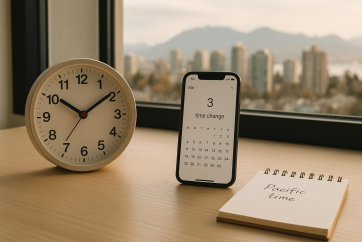
British Columbia's official decision has already been made. The provincial government has announced that the clock change on Sunday, March 8, 2026, will be the last seasonal time change for most of B.C. After that, residents and businesses will have eight months to adapt, and on November 1, 2026, when the transition to daylight saving time usually occurs, the clocks will no longer be changed. The new permanent time regime is called Pacific time (UTC-7) in the government release.
B.C. Premier David Eby explained the decision as an effort to reduce inconvenience for families and businesses and improve people's well-being. In an official release, the B.C. government directly points to less sleep disruption, easier planning, and an extra hour of evening light in winter as key arguments in favor of the change.
At the same time, there is an important detail: the changes do not affect all of British Columbia equally. The B.C. government has clarified that some eastern parts of the province, which live on mountain time, will not automatically switch to the new regime. In particular, some communities in southeastern B.C. will remain synchronized with Alberta and will continue to change the time seasonally if Alberta itself does not change anything.
This is not a new issue for Alberta. In 2021, the province held a referendum on switching to permanent daylight saving time. According to official counts by Elections Alberta, 50.1% of voters voted against the change, while 49.9% voted in favor. After that, the province kept the current system of changing the clocks twice a year. The Alberta government's page on this topic still states that the referendum result is binding.
So, as of March 3, 2026, British Columbia has already made its decision and is switching to permanent daylight saving time, while Alberta is only analyzing the possible consequences and has not yet announced a change in its policy. If the Smith government decides to revisit this issue formally, the debate will almost certainly focus again on the choice between stability within the Western Canadian region and the results of the 2021 referendum.