
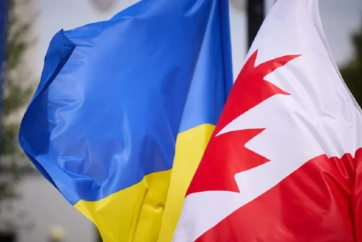
After Russia launched a full-scale invasion in 2022, Canada introduced special temporary measures for Ukrainians. The Canada-Ukraine Authorization for Emergency Travel (CUAET) program became a “fast track” for those fleeing the war. However, in the fourth year of the war, more and more people in Canada find themselves in limbo: they work, pay taxes, and build lives, but have no separate nationwide mechanism that would provide a clear path to permanent residence (PR).
CUAET: temporary protection that has “dragged on”
CUAET was launched as a temporary special measure in March 2022 to quickly help Ukrainians and their families fleeing the war. According to the Canadian government, Canada has accepted nearly 300,000 Ukrainians and their family members under CUAET.
In February 2025, IRCC (Immigration, Refugees and Citizenship Canada) extended the opportunity for some people under CUAET to apply for a new open work permit/open work permit extension/new study permit—if they arrived in Canada before March 31, 2024. The final deadline for applications is March 31, 2026 (usually with standard fees).
It is important to note that this decision is about extending temporary status, not about “automatic PR.” In other words, it gives people time to stay legally and work/study, but it does not solve the main question: what to do with those who have already integrated and do not plan to return in the near future due to security risks.
Why standard PR tools are not suitable for everyone
Officially, Ukrainians can try to go through the “usual” channels — for example, through Express Entry or provincial programs. But in practice, many people face barriers: language tests, lost documents/diplomas due to the war, age criteria that reduce their chances in the points system, and other formal requirements. That is why communities insist on a separate, more adapted mechanism.
Letter campaign and parliamentary petition: what communities are demanding
According to information from publications by Ukrainian communities in Canada, activists have launched campaigns to appeal to MPs and collect signatures for petitions. In particular, there is mention of the United Ukrainians for Canada Foundation initiative, which has sent tens of thousands of letters to parliamentarians demanding the creation of a separate path to PR.
The e-6866 e-petition on the Canadian House of Commons website attracted particular attention. It was:
- initiated by John Stadnyk (Calgary, Alberta),
- supported in parliament by MP Yvan Baker (Etobicoke Centre, Ontario),
- opened for signature on October 15, 2025, and closed on February 12, 2026, at 1:14 p.m. (EDT),
- as of the petition page — 46,233 validated signatures.
The key demand of the petition is to create a one-time special PR pathway for people who are in Canada under CUAET and other temporary “emergency” programs. The text also proposes indicative criteria that the government could consider: length of legal residence in Canada, Canadian work experience, basic language/education requirements, and signs of integration (e.g., children in school, education, volunteering, etc.).
What alternatives already existed — and why they are considered insufficient
Canada already had targeted solutions for some Ukrainians. For example, IRCC launched a family PR pathway for Ukrainians with relatives in Canada, but this tool was time-limited and closed on October 22, 2024 (although submitted applications continue to be reviewed).
There is also the Provincial Nominee Program, but eligibility and requirements vary significantly between provinces, and quotas may be limited.
In January 2026, IRCC announced another “bridge” measure — relief for those who have applied through the family route and are awaiting a decision: such people were given more options to extend their legal status, obtain/extend work or study permits. But again, this is a solution for a specific group, not a universal PR path for all CUAET holders.
What's next
For now, the situation looks like this: the government is continuing with temporary mechanisms so that people can legally stay and work, but the question of a general, clear PR path for a broad group of Ukrainians in Canada remains open.
Source: Toronto Star