
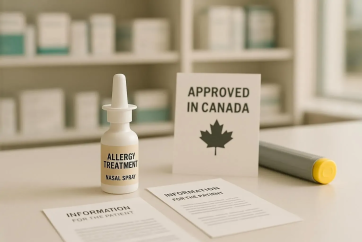
A new treatment option for severe allergic reactions has officially become available in Canada. On April 15, 2026, ALK Canada and ARS Pharmaceuticals announced that Health Canada had approved neffy 2 mg—a nasal spray containing epinephrine for the emergency treatment of anaphylaxis in adults and children weighing 30 kilograms or more.
This is a significant change for people at risk of sudden severe allergic reactions, as epinephrine auto-injectors, such as the EpiPen, have remained the standard for emergency self-treatment in Canada until now. Now, instead of an injection, there is another option—a nasal spray that can be used immediately at the first signs of a dangerous reaction.
What exactly has been approved in Canada
According to official data, neffy 2 mg is approved for the emergency treatment of allergic reactions, including anaphylaxis, caused by insect bites or stings, food, medications, other allergens, as well as idiopathic or exercise-induced anaphylaxis.
For now, the Canadian approval applies only to the 2 mg dose for patients weighing 30 kg or more. ARS Pharmaceuticals separately announced that it plans to submit an application for Canadian approval of the 1 mg dose for children weighing 15 to 30 kg later, in the summer of 2026.
Why This Matters
It is important to understand the essence of this news correctly: this is not a “medicine for allergies” in the usual sense, nor is it a treatment for a chronic disease, but rather an emergency medication to stop a dangerous reaction that can develop very quickly.
Food Allergy Canada emphasizes that anaphylaxis is a severe and potentially life-threatening reaction, and epinephrine is the only medication capable of stopping its symptoms. The organization also stresses that rapid administration of epinephrine is critically important for the best outcome.
This is why the approval of neffy is significant. An official statement from ALK Canada notes that many people with severe allergies do not always carry an auto-injector with them or hesitate to use it in a critical moment. One reason cited is fear of needles and uncertainty about administering the medication correctly. The needle-free spray has the potential to lower this barrier and make emergency treatment easier for patients, parents, and caregivers.
What is known about side effects
The company reports that Canadian approval was granted following clinical trials involving over 700 participants, and no serious side effects were reported in these studies.
The most commonly reported adverse reactions included throat irritation, headache, nasal discomfort, and feelings of tremor or nervousness, with the ALK Canada press release noting that these reactions were more frequently observed after the second dose.
What Patients Need to Know
At the same time, neffy does not replace standard procedures for anaphylaxis. Official information from ARS Pharmaceuticals states that after the first dose, if symptoms persist or worsen, a second dose may be needed after 5 minutes, and emergency medical care should be sought after using the medication.
In other words, the nasal spray is a new rapid-response tool, but not a substitute for further medical supervision.
Another important detail: the drug has already been approved, but it is not expected to be available in Canadian pharmacies until the summer of 2026. This means that patients at risk of anaphylaxis should continue to rely on existing auto-injectors for now, if that is what has been prescribed for them.