
Important changes to the rules regarding citizenship by descent have come into effect in Canada. These changes may affect people who were born outside of Canada but have Canadian parents, grandparents, or another family connection to a Canadian citizen.
At first glance, this sounds like a very narrow topic that affects only a small number of families. But in reality, the changes could be significant for many people in various countries, particularly those who have never lived in Canada but have Canadian ancestry.
This refers to Bill C-3—a law that changed the so-called first-generation limit rule. Previously, Canadian citizenship by descent was limited primarily to the first generation born outside the country. Simply put, if a Canadian was born in Canada or naturalized in Canada, their child born abroad could usually obtain citizenship by descent. But the next generation often fell under the restrictions.
This is precisely why many people with genuine family ties to Canada could not automatically be considered citizens. This rule had been criticized for years, and in 2023, an Ontario court ruled that some of these restrictions were unconstitutional for many people. Following this, the federal government began amending the legislation, and eventually Bill C-3 came into effect on December 15, 2025.
What does this mean in practice?
If a person was born outside Canada before December 15, 2025 and has a father or mother who was a Canadian citizen at the time of their birth, they may already be a Canadian citizen. In some cases, this may even apply to second-generation or later generations born abroad.
That is why Canadian immigration materials now often include a simple phrase: if your grandfather or grandmother was Canadian, it’s worth checking whether you are eligible for Canadian citizenship.
But it’s important not to jump to conclusions here. The mere fact that a relative lived in Canada or held a Canadian passport does not automatically grant citizenship to all descendants. You need to examine the specific family chain: who exactly was a citizen when the next person in the family was born, where they were born, and whether there was a loss of citizenship, adoption, a change in the law, or other circumstances.
For people born or adopted outside Canada after December 15, 2025, the rules are different. In such cases, if the Canadian parent was also born or adopted outside Canada, a so-called substantial connection to Canada must be proven. This means that the Canadian parent must demonstrate at least 1,095 days of physical presence in Canada prior to the child’s birth or adoption. 1,095 days is approximately three years.
In other words, the new rules do not mean that citizenship is now passed down to all generations without restriction in every situation. On the contrary, Canada is trying to strike a balance: on the one hand, to correct the injustice for people who were previously excluded under the old rules, and on the other, to maintain the requirement of a genuine connection to the country for future generations.
What should a person do if they suspect they may be a Canadian citizen?
The first step is to gather documents. Typically, you need to prove the family connection across generations. These can include birth certificates, name change documents, marriage certificates, adoption records, old Canadian passports, citizenship certificates, naturalization records, or other official documents.
For example, if a person believes they are eligible for citizenship through a grandparent, they must document the entire chain: the grandparent was a Canadian citizen, then their child was documented as their child, and then the applicant is the child of that person. Without documents, such a case can be complicated, even if the family history seems obvious.
The second step is to apply for proof of citizenship, that is, a citizenship certificate. This is not the same as a standard immigration application for citizenship after obtaining permanent residence. In this case, the person is not “applying for” citizenship from scratch, but is asking Canada to officially confirm that they are already a citizen by law.
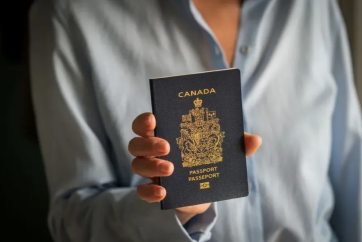
If IRCC confirms citizenship, the person will be issued a citizenship certificate. It is this document that can then be used to apply for a Canadian passport. A Canadian passport, in turn, is required for traveling to Canada as a citizen to avoid problems or delays at the border.
This is especially important for people planning to travel to Canada. IRCC explicitly advises obtaining confirmation of citizenship first, then a Canadian passport, and only then traveling to Canada as a citizen. If a person is potentially a citizen but lacks documentary proof, this can create confusion when crossing the border or submitting other applications.
This topic may also be of interest to Ukrainians. Some Ukrainian families have a long history of emigration to Canada, particularly due to waves of migration in the 20th century. Some people have relatives who were born in Canada, then returned or moved to another country. For others, Canadian citizenship may have been passed down through generations, but the family never gave it much thought.
Of course, most people who simply have distant relatives in Canada will not automatically become citizens. But if there is a direct family connection through parents, a grandmother, or a grandfather—especially if they were Canadian citizens—it’s worth at least checking the situation according to official rules.
It’s also important not to confuse citizenship by descent with permanent residence, work permits, CUAET, or other immigration programs. This is a completely different process. If a person is indeed a Canadian citizen by descent, they don’t need to go through the standard immigration route via PR to become a citizen. But this must be officially proven with documents.
The new rules under Bill C-3 do not mean that everyone with a Canadian relative will automatically receive a passport. But they open the door for people whom the old system effectively left without citizenship due to first-generation technical restrictions.So the main advice is simple: if your family has Canadian roots, especially through parents, a grandmother, or a grandfather, it’s worth checking this not based on hearsay, but through the official IRCC rules. Perhaps you don’t just have a family history connected to Canada. Perhaps you’re already eligible for official confirmation of Canadian citizenship.
Source: Canada.ca: https://www.canada.ca/en/immigration-refugees-citizenship/services/canadian-citizenship/act-changes/rules-2025.html