
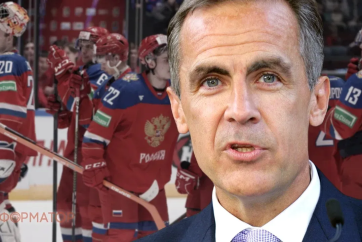
Canadian Prime Minister Mark Carney stated that the Russian national team will not participate in the 2027 World Junior Hockey Championship, which will be held in Edmonton and Red Deer. Canada announced this position following an unexpected ruling by the Court of Arbitration for Sport, which ordered Russia’s reinstatement to international hockey competitions.
The championship will begin on December 26, 2026, and run through January 5, 2027. For Alberta, this is one of the biggest sporting events of the season, set to bring together the world’s best young hockey players and thousands of fans.
However, a few weeks before the tournament’s start, a controversy arose regarding its participants. Russia, which had been suspended from international hockey competitions following its full-scale invasion of Ukraine, received a ruling in its favor from the sports arbitration court.
Canada responded categorically: there will be no official Russian delegation at the tournament in Alberta.
What did Canadian Prime Minister Mark Carney say?
On November 3, 2026, while attending the Commonwealth of Nations summit in Antigua, Mark Carney answered journalists’ questions regarding the possible return of Russian hockey players to the international arena.
The prime minister emphasized that Canada’s position remains unchanged: as long as Russia continues its war against Ukraine with the support of Belarus, these countries should not be officially represented at international sporting events held in Canada.
Carney also commented specifically on the upcoming World Junior Championship in Alberta.
He stated unequivocally that the Russian national team will not participate in this tournament.
This is an important clarification, as doubts had arisen following a decision by the Court of Arbitration for Sport regarding whether the tournament organizers would be able to maintain the original roster of participants.
The Canadian federal government has now clearly stated its position.
Why did the question of Russia’s return even arise?
Russian and Belarusian hockey teams were suspended from International Ice Hockey Federation (IIHF) tournaments following the start of Russia’s full-scale invasion of Ukraine in 2022.
In July 2026, the IIHF reconsidered the issue of their participation in the 2026–2027 season championships.
The federation decided to bar Russian teams from a number of international tournaments, including the World Junior Championship in Alberta.
The IIHF justified its decision by citing concerns for the safety of participants, organizational risks, and the need to protect the sporting integrity of the competitions.
However, the Russian Ice Hockey Federation challenged the restrictions in the Court of Arbitration for Sport (CAS).
On October 30, 2026, the IIHF announced that CAS had ruled to allow the Russian federation to enter teams in international championships.
The decision applied to five tournaments in 2027, including the World Junior Championship.
This posed a serious problem for international hockey, as there were less than two months remaining before the start of the upcoming tournament.
How did the International Ice Hockey Federation react?
The IIHF openly expressed its disappointment with the Court of Arbitration for Sport’s decision.
The federation emphasized that its previous restrictions were related not only to the war but also to the safety of athletes, coaches, staff, and fans.
At the same time, the IIHF acknowledged the CAS’s authority and stated that it would explore ways to implement its decision.
But there is another problem—the organization of the tournaments themselves.
At the time the decision was made, the participants had already been determined, the match schedules approved, the groups assigned, and ticket sales had begun.
The return of yet another national team would require a revision of these arrangements.
The federation noted that the sports arbitration ruling does not take into account all the practical difficulties associated with such changes.
Canada Issued an Official Statement Regarding Russian and Belarusian Athletes
On November 3, 2026, the Canadian federal government published a joint statement from three officials:
- Anita Anand, Minister of Foreign Affairs.
- Lena Metlege Diab, Minister of Immigration, Refugees, and Citizenship.
- Adam van Koeverden, State Secretary for Sport.
In the document, the government confirmed that Canada will continue to oppose the participation of athletes who officially represent Russia or Belarus under their national flags, with national symbols, colors, or anthems.
Canadian authorities explain this position by their unwillingness to allow international sporting events to be used to enhance the international prestige of states involved in the war against Ukraine.
The government also noted that since the start of the full-scale invasion, Canada has provided Ukraine with over 26 billion Canadian dollars in aid and imposed sanctions against more than 4,200 individuals, organizations, and vessels.
Can Russian hockey players be denied entry to Canada?
Yes, and this is one of the most important points of the official statement.
Canada’s Ministry of Immigration announced its intention to exercise the powers provided for in subsection 22.1(1) of the Immigration and Refugee Protection Act.
This allows the Minister of Immigration to make individual decisions regarding the admissibility of foreign nationals.
In the case of Russian and Belarusian athletes and sports officials, these powers may be used to prevent their entry into Canada for the purpose of competing under their national flags.
Important: This is not a blanket entry ban on all citizens of Russia or Belarus.
The government is specifically referring to the case-by-case review of athletes and officials who plan to officially represent their countries at international sporting events.
Thus, even if a sports organization allows a team to participate in a competition, this does not guarantee that its representatives will be able to enter the host country.
What about athletes competing under a neutral status?
The Canadian government has specifically emphasized that individual athletes competing under a neutral status may continue to participate in international sporting events on Canadian soil.
In other words, the restrictions are primarily aimed at the official representation of Russia and Belarus.
The difference is that a neutral athlete does not represent a country under its flag, national anthem, or other national symbols.
At the same time, the possibility of individual participation under neutral status does not mean that the Russian national hockey team can automatically secure a spot in the World Championship.
Furthermore, sporting events that receive funding from the Canadian federal government must comply with restrictions on the official participation of Russian and Belarusian athletes under national symbols.
How Are Other Hockey Nations Responding?
The CAS decision has sparked controversy not only in Canada.
A number of European hockey federations have also spoken out against the return of Russian national teams to international competition.
In particular, hockey officials from Finland, Norway, Sweden, Denmark, and the Czech Republic have announced their refusal to play matches against Russia.
For these countries, the issue concerns not only sports regulations but also the safety of participants and their stance on the war against Ukraine.
A particularly difficult situation could arise at tournaments where national teams are scheduled to face a Russian team based on the draw or the schedule.
Refusing to take the ice could potentially lead to disciplinary consequences in accordance with competition regulations.
Therefore, international hockey organizations will have to find a solution that takes into account both the ruling of the sports arbitration body and the positions of the national federations.
Where and when will the 2027 IIHF World Junior Championship take place?
The 2027 IIHF World Junior Championship will be hosted by two cities in Alberta—Edmonton and Red Deer.
Key information about the tournament:
- Dates: December 26, 2026 – January 5, 2027.
- Cities: Edmonton and Red Deer, Alberta.
- Main arena: Rogers Place in Edmonton.
- Second venue: Marchant Crane Centrium in Red Deer.
- Number of participants according to the published schedule: 10 national teams.
- Number of games: 29, excluding exhibition games.
According to the official IIHF schedule, the teams are divided into two groups.
Group A — Red Deer
- Finland.
- Germany.
- Slovakia.
- Sweden.
- United States.
Group B — Edmonton
- Canada.
- Czech Republic.
- Latvia.
- Norway.
- Switzerland.
Group stage matches will take place in both cities.
The semifinals are scheduled for January 4, and the medal games for January 5, 2027, at Rogers Place.
As of this writing, the official tournament schedule does not include the Russian national team.
Why Is This Important for Alberta?
For Edmonton and Red Deer, hosting the World Junior Championship is a major sporting and economic event.
Teams, coaches, journalists, and fans from various countries will come to the province.
Increased demand is expected for hotels, restaurants, transportation, and other local services.
The Alberta government previously announced $11 million in funding for hockey events in the province, including the 2027 World Junior Championship.
For Alberta’s Ukrainian community, this story has another significance.
Many Ukrainians live in Calgary, Edmonton, and other cities, including people who moved to Canada after the start of the full-scale invasion.
Therefore, the question of the Russian national team’s participation in a major international tournament taking place in their province goes far beyond ordinary sports news.
Has the issue of Russia’s participation been definitively resolved?
As of November 5, 2026, the Canadian federal government’s position is unequivocal: the Russian national team should not officially represent its country at the World Junior Championship in Alberta.
At the same time, it is important to distinguish between several aspects.
The Court of Arbitration for Sport has ruled on the Russian Ice Hockey Federation’s right to participate in international competitions.
The IIHF must take this ruling into account and determine its practical implications for tournaments.
The Canadian federal government, for its part, has its own authority regarding the admission of foreign athletes into the country and the conditions for their participation in sporting events.
Therefore, Mark Carney’s statement represents an important political and governmental position, but it does not replace all the necessary organizational and legal procedures.
Further decisions by the IIHF and Hockey Canada will determine exactly how the situation will be resolved.
Conclusion
Canada has confirmed that it does not plan to allow an official Russian delegation to participate in the 2027 World Junior Hockey Championship in Alberta.
Prime Minister Mark Carney explicitly stated that the Russian national team will not be present at the tournament, despite the Court of Arbitration for Sport’s decision to reinstate Russia in international hockey competitions.
The federal government has also confirmed its readiness to use immigration measures to restrict the entry of athletes and officials who plan to represent Russia or Belarus under national symbols.
At the same time, individual athletes competing as neutrals may continue to participate in international sporting events in Canada.
The World Junior Championship itself will take place from December 26, 2026, to January 5, 2027, in Edmonton and Red Deer.
The currently published tournament schedule calls for the participation of ten national teams, excluding Russia.
Final organizational decisions regarding the implications of the CAS ruling remain with the relevant sports bodies and the championship organizers.