
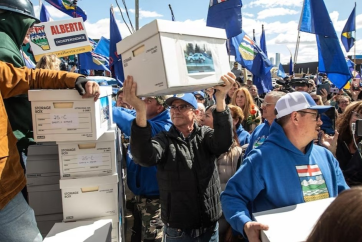
Mass protests are expected in Alberta this weekend. On Saturday, October 17, residents of at least 15 cities across the province plan to take to the streets to express their opposition to the policies of Daniel Smith’s government. The following day, October 18, a separate rally will take place outside the Legislative Assembly building in Edmonton.
The protests come on the eve of a major political event. On Monday, October 19, Alberta will hold a referendum in which residents will be asked to answer ten questions. Half of them directly concern immigration, access to public services, and the rights of temporary residents.
For a province home to hundreds of thousands of immigrants, including Ukrainians, this is more than just a political debate. The proposed changes could affect who is eligible for certain social programs, whether temporary residents will have to pay extra for public services, and how Alberta’s immigration system will function in the future.
We’ll explain what’s happening, why the protests are being organized, and what issues will be put to a vote.
Protests will take place in at least 15 cities across Alberta
The province-wide action is being organized by the Alberta Federation of Labour (AFL), which represents the interests of workers and labor unions.
The actions are part of the Fight Back Now! campaign, which opposes a series of decisions and initiatives by the provincial government.
For Saturday, October 17, organizers have announced 16 protest events in 15 cities across Alberta.
These include Calgary, Red Deer, and other communities in the province.
In Calgary, participants plan to gather at 800 Macleod Trail SE. The event is scheduled from 11:00 a.m. to 1:30 p.m.
In Red Deer, the protest will take place at 4914 48 Avenue, from 11:00 a.m. to 1:00 p.m.
A separate event is scheduled in Edmonton for Sunday, October 18. Participants will gather near the Alberta Legislative Assembly building at 10800 97 Avenue NW. The event begins at 1:00 p.m. and is scheduled to end at 3:00 p.m..
The organizers are calling on residents of the province to join the protests and voice their views on the government’s decisions.
At the same time, it is important to understand that the Fight Back Now! campaign covers a broader range of issues than just immigration. Among the topics raised by participants are public services, workers’ rights, funding for social services, and the government’s political agenda.
Why are the protests happening right now?
The timing of the protests is no coincidence.
This coming Monday, October 19, a referendum initiated by Premier Danielle Smith’s government will take place in Alberta.
Residents of the province will be asked to answer ten questions regarding immigration, social policy, electoral rules, and other issues concerning Alberta’s future.
Five of the questions are directly related to immigration policy.
It is this part of the referendum that is drawing particular attention, as potential changes could affect a large number of people who live and work in the province but do not yet have Canadian citizenship or permanent resident status.
The government cites the growing strain on public services as the reason for revising the rules.
Critics, however, fear that the proposed measures could create additional financial and administrative hardships for immigrants.
What immigration issues will be put to a referendum?
One of the main topics of the vote will be the province’s role in shaping immigration policy.
Currently, most key decisions regarding the entry of foreign nationals into Canada, the issuance of work and study permits, and the granting of permanent residency are made at the federal level.
The provinces have their own immigration programs and certain powers, but they do not control the entire system.
The Alberta government wants more authority to influence immigration processes and access to certain government programs.
Among the issues put to a vote are the following:
1. More Authority for Alberta in Immigration Policy
Residents will be asked to voice their opinions on expanding the province’s role in making immigration decisions.
The government believes that Alberta should have more influence over how many people come to the province and how immigration meets the needs of the local economy.
Supporters of this approach emphasize that the province has a better understanding of its own labor market, the needs of employers, and the capacity of its social infrastructure.
Critics point to the risk of complicating the immigration system and potential discrepancies between federal and provincial rules.
2. Access to Social Programs Based on Immigration Status
Another issue concerns the possibility of imposing additional restrictions on access to certain provincial social services.
The question is whether a person’s immigration status should affect their right to access certain support programs.
This topic is controversial, as many temporary residents work in Alberta, pay taxes, and participate in the province’s economic life.
At the same time, the government emphasizes the need to ensure the financial sustainability of social programs.
3. Waiting Period for Social Assistance
The possibility of introducing a 12-month residency requirement before receiving certain types of social assistance will be considered separately.
The idea is that a person must first live in Alberta for a specified period of time before gaining access to certain programs.
For newly arrived immigrants, this requirement could have practical implications.
The first few months after moving are often spent looking for work, finding housing, sorting out paperwork, and adjusting to a new environment.
It is during this period that some families may need support the most.
However, the specific implications will depend on which programs might be subject to the new rules, should the government decide to implement them.
4. Potential Fees for Health and Education Services for Temporary Residents
This is one of the most sensitive issues for foreign nationals living in Alberta.
Residents are being asked to share their views on the possibility of introducing additional fees for certain public services for temporary residents.
This potentially involves the areas of health care and education.
For families living in Canada on work or study permits, this prospect raises legitimate questions.
Will they have to pay extra for their children’s education in public schools? Will health insurance rules change? Will there be exceptions for people who work and pay taxes?
For now, the answers to these questions depend on future government decisions.
The referendum itself does not establish new fees or revoke existing rights to receive services.
5. Verification of Canadian Citizenship When Voting
Another issue concerns the rules for participating in provincial elections.
There is a proposal to tighten the requirements for verifying voters’ Canadian citizenship.
It is worth noting that only Canadian citizens who meet the established electoral requirements already have the right to vote in Alberta’s provincial elections.
Therefore, the debate does not concern granting or revoking the right to vote for immigrants, but rather the method of verifying citizenship.
Supporters of additional checks view them as a tool to protect the electoral process.
Critics point to potential difficulties for citizens who do not have the necessary documents on hand.
The referendum will also address the issue of Alberta’s future as part of Canada
Immigration is not the only issue on the ballot.
Among other questions is one concerning the possible initiation of legal proceedings to hold a separate referendum on Alberta’s secession from Canada.
It is important not to confuse these two votes.
On October 19, the province’s residents will not be making a direct decision on Alberta’s independence.
This is a consultation on possible future political and legal steps.
The issue of Alberta’s secession has long been a part of the province’s political discourse, particularly in the context of its relationship with the federal government.
However, any actual process to change the province’s constitutional status would be far more complex than a single vote.
How many temporary residents live in Alberta?
According to estimates cited in reports on the referendum, there are approximately 271,000 non-permanent residents living in Alberta.
This category may include foreign nationals with work permits, international students, asylum seekers, and other individuals residing in Canada on a temporary basis.
The exact number depends on the date of the statistical survey and the counting methodology.
For Alberta, this represents a significant portion of the population.
Temporary residents work in construction, the restaurant industry, transportation, the service sector, healthcare, and many other fields.
Among them are Ukrainians who arrived in Canada after the start of Russia’s full-scale invasion of Ukraine.
Some of these people have already obtained permanent residency, while others continue to work under temporary permits or are awaiting decisions on their immigration applications.
Therefore, the issue of access to public services directly affects many families.
Why Are Immigrants Divided in Their Opinions?
There is no unified position among immigrants themselves regarding the proposed changes.
Some support the idea of revising the rules.
They believe that rapid population growth places an additional strain on hospitals, schools, the housing market, and infrastructure.
In their view, the government should take into account the province’s actual capacity to provide services to all residents.
Others fear that the new restrictions could unfairly affect people who live legally in Canada, work, pay taxes, and plan to stay here for the long term.
Of particular concern is the possibility of additional fees for medical and educational services.
For families with children, even relatively small additional expenses can significantly impact their budget.
There are also those who have not yet decided on their position, as the specific details of the upcoming changes have not yet been finalized.
Will the rules change immediately after October 19?
No. And this is perhaps the most important point for everyone who is worried about the possible consequences of the referendum.
The October 19 vote is advisory in nature.
This means that its results will reflect voters’ positions on the proposed issues but will not automatically change the law.
Even if a majority of voters supports a particular proposal, the government will still have to separately draft and adopt the necessary legislation.
In some cases, amendments to provincial legislation may be required.
In others, negotiations with the federal government will be necessary, as some of the issues fall under Ottawa’s jurisdiction.
The Alberta government has stated its intention to determine the next steps later this fall.
Therefore, October 19 does not mean the automatic introduction of tuition fees, the abolition of health insurance, or changes to the immigration status of temporary residents.
What Does This Mean for Ukrainians in Alberta?
For Ukrainians living in Calgary, Edmonton, Red Deer, and other cities in the province, the referendum should be viewed primarily as a political event that could influence future government policy.
Those in Canada on temporary work or study permits should pay particularly close attention to how the situation develops.
However, there is currently no reason to believe that the terms of existing permits, access to school education, or health insurance will automatically change following the vote.
If the government decides to introduce new rules, the relevant regulations, specific conditions, and effective dates must be made public.
It is also important to remember that temporary residents and permanent residents are not eligible to vote in provincial elections and referendums unless they are Canadian citizens.
At the same time, they may participate in public discussions, peaceful protests, and other lawful forms of expressing their views.
Where will the protests take place, and how can you find out more details?
The organizers of the Fight Back Now! campaign have published information about planned events on their official website.
Key Dates:
- October 17, Saturday — Province-wide Day of Protest, with events in at least 15 cities.
- October 17, Calgary — 11:00 a.m.–1:30 p.m., 800 Macleod Trail SE.
- October 17, Red Deer — 11:00 a.m.–1:00 p.m., 4914 48 Avenue.
- October 18, Sunday, Edmonton — 1:00–3:00 p.m., near the Alberta Legislative Assembly, 10800 97 Avenue NW.
- October 19, Monday — the main day of the referendum.
Organizers recommend checking for updates right before the events, as times and locations may be subject to change.
What Happens After the Referendum?
Regardless of the voting results, the debate over immigration and public services in Alberta is unlikely to end on October 19.
The province continues to grow, and as the population increases, so does the demand for housing, healthcare, schools, and transportation infrastructure.
The government is trying to find ways to manage the strain on the budget and public institutions.
At the same time, businesses need workers, and many sectors of the economy depend on people coming from other countries.
It is precisely between these two needs—ensuring the availability of public services and supporting economic development—that much of the current debate is centered.
The protests on October 17–18 will provide an opportunity for the province’s residents to publicly express their views. And the October 19 referendum will reveal the level of support among voters for the government’s proposed policies.
However, any specific changes, if they occur, will depend on further decisions by the Alberta government and, on certain issues, by the federal government of Canada.
Therefore, for immigrants—particularly Ukrainians—the most important thing right now is to follow official announcements and distinguish between the issues put to a vote and the laws that have already taken effect.