
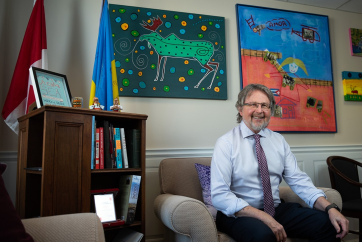
On February 3, 2026, Nova Scotia Senator Stan Kucher stated in the Canadian Senate that the current mechanisms for applying for permanent residence (PR) for Ukrainians living and working in the country after arriving under the CUAET program have become “barriers” rather than real “pathways.” He called on the government to open a temporary pathway to PR to resolve the issue of delays and uncertainty for tens of thousands of people.
“This is not a pathway. This is a barrier.”
During the Senators' Statements, Katcher told the story of a Ukrainian woman named Gala, who came to Canada in 2022, works, pays taxes, and is raising two children, but is forced to constantly renew her documents so as not to lose her right to work and access to basic services.
According to the senator, Gala applied for PR on humanitarian and compassionate grounds, but, citing IRCC estimates, Katcher said that the wait for consideration could be decades — “up to 50 years.”
He also mentioned the special Family Reunification Public Policy program, introduced in October 2023 and closed a year later: according to him, it is inaccessible to many people, and the processing of applications is too slow. Katcher cited the figures: approximately 15,000 applications and about 1,000 processed at that time. “This is not a pathway. It's a roadblock,” he concluded.
The senator also stressed that the government has the authority to “open a temporary path to PR” if it makes the appropriate political decision.
Government request: “Will there be a decision?”
On the same day, Katcher raised the issue during Question Period, addressing the government representative in the Senate, Pierre Morneau. He reiterated that under the two existing mechanisms, Ukrainians could face a “50+ year” wait and asked for a decision to be announced.
Morneau responded that the situations were “painful,” recalled that Canada had accepted more than 220,000 Ukrainians since the start of the full-scale Russian invasion, and promised to raise the issue with the immigration minister. At the same time, he noted that he could not comment on future political decisions.
Katcher, in turn, stressed that the minister “can create a temporary path to permanent residence if he wants to” and asked directly whether the government knows if such a step will be taken.
Context: CUAET provided temporary status, but the question of “what next” remains open
The Canada-Ukraine Authorization for Emergency Travel (CUAET) program was launched as a temporary protection and residence tool, allowing Ukrainians and their family members to live, work, and study in Canada. Applications for CUAET visas could be submitted until July 15, 2023, after which the acceptance of applications was closed.
That is why, as representatives of the Ukrainian community explain, the issue of a predictable and realistic transition from temporary status to PR for those who have already integrated, work, and raise children in Canada is becoming increasingly acute. In particular, the Ukrainian Canadian Congress has previously publicly supported calls for the creation of a separate PR track for some CUAET holders.