
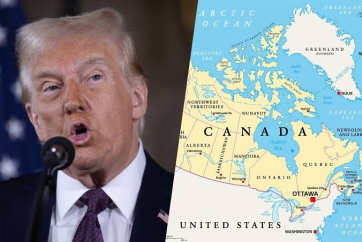
U.S. President Donald Trump has once again raised the possibility of Canada joining the United States. This time, he stated that America’s northern neighbor will sooner or later become its 51st state, since, in his view, this is the most logical course of events.
The statement was made on October 14, 2026, during a campaign rally in Bullhead City, Arizona.
Trump did not limit himself to discussing Canada’s future. He also criticized trade relations between the two countries, mentioned Canadian tariffs on dairy products, the relocation of automobile plants to the U.S., and even revisited the idea of renaming Lake Ontario.
This is far from the first time the U.S. president has raised the topic of the 51st state. However, against the backdrop of strained relations between Ottawa and Washington, such statements are once again drawing the attention of Canadians.
What exactly did Donald Trump say?
Speaking to supporters in Arizona, Trump once again expressed his conviction that Canada will eventually become part of the United States.
According to CTV News, the U.S. president explained his position by citing Canada’s economic dependence on the American market.
“We don’t need them, but they need us,” Trump said.
He also questioned the wisdom of the current economic relationship between the two countries. According to the U.S. president, the United States spends too much money supporting Canada without receiving sufficient benefits in return.
Trump claimed that the United States is allegedly losing billions of dollars due to its trade relations with Canada.
However, it is important to understand that such statements are the president’s own political assessment, not confirmed evidence that the U.S. economy is financing Canada’s existence.
Canada remains an independent nation with its own economy, government, legislation, and international obligations.
Why Is Trump Criticizing Canada Again?
A significant portion of the speech was devoted to the economy.
Trade relations between Canada and the U.S. have long been one of the main topics of political debate.
The two countries are closely intertwined. Goods are transported across the shared border daily, businesses operate within integrated supply chains, and many companies have factories and offices on both sides of the border.
That is why any changes in trade policy can have a significant impact on business, jobs, and prices.
During his speech, Trump raised several issues that have long been a source of frustration for him.
Canadian Tariffs on Dairy Products
One of the topics that came up again was Canada’s dairy market protection system.
Canada operates a supply management system that regulates the production and import of certain types of agricultural products, including milk.
High tariffs may be imposed on imports exceeding established quotas.
Trump has repeatedly criticized this system, considering it unfair to American farmers.
Canada, for its part, has traditionally defended the supply management mechanism as a tool to support its own producers and ensure stability in the agricultural sector.
Automobile Plants and Jobs
Another issue is the automotive industry.
Trump has spoken about relocating production to the United States, presenting this as a positive outcome of American economic policy.
For Canada, the automotive sector is of particular importance.
Ontario is home to major automotive companies, and the production of vehicles and components is closely integrated with the U.S. industry.
The relocation of production between countries can affect thousands of jobs, investments, and the economic development of entire regions.
That is precisely why statements about the future of the automotive industry cause significantly more concern in Canada than ordinary political disputes.
Trump Again Mentioned Renaming Lake Ontario
Among the economic statements, a rather unusual topic was raised.
The U.S. president once again raised the issue of possibly renaming Lake Ontario Lake America.
Such ideas have repeatedly been the subject of discussion since Trump began actively using geographical names in his political rhetoric.
Lake Ontario is one of the five Great Lakes of North America and is located on the border between Canada and the United States.
Its waters wash the shores of the Canadian province of Ontario and the U.S. state of New York.
However, the mere mention of a possible renaming does not mean that the lake’s name has been officially changed.
What Does Greenland Have to Do with It?
Another unexpected moment in the speech was the comparison of Canada to Greenland.
Trump suggested that Canada might go through a process similar to the one he associates with Greenland.
However, the president did not explain exactly what he meant.
Greenland is an autonomous territory within the Kingdom of Denmark, and Trump has previously expressed interest on multiple occasions in establishing U.S. control over the island.
However, the situation with Canada is fundamentally different.
Canada is a sovereign state, a member of the G7, NATO, and many international organizations. It has its own Constitution, democratic institutions, and an independent system of government.
Therefore, the comparison with Greenland serves more to illustrate the U.S. president’s political views than to explain any realistic mechanism for changing Canada’s status.
Could Canada Really Become the 51st State of the U.S.?
Despite the sensational nature of the statement, there is a vast legal and political gulf between the U.S. president’s words and the actual annexation of an independent state.
Canada is not U.S. territory, and the U.S. president does not have the authority to unilaterally change its statehood.
Any process of this magnitude would require fundamental decisions on the part of Canada itself, complex constitutional procedures, and corresponding decisions by U.S. government institutions.
Furthermore, Canada has its own political system, ten provinces, three territories, and special constitutional relationships with Indigenous peoples.
The annexation of such a state by another country cannot occur solely because of the desire of a single political leader.
At present, there is no confirmation that Trump’s October 14 statement is backed by a specific, agreed-upon plan to unite the two countries.
How is Canada responding to such statements?
The topic of a 51st state has repeatedly come up in relations between Donald Trump and Canadian politicians.
Canadian leaders have consistently emphasized that the country is an independent state and that its future is determined by Canadians themselves.
Prime Minister Mark Carney has also previously rejected the possibility of Canada becoming a U.S. state.
At the same time, Ottawa is compelled to maintain working relations with Washington.
The U.S. remains Canada’s key trading partner, and the two countries cooperate on defense, border security, energy, and international policy.
That is precisely why the Canadian government must simultaneously defend the country’s sovereignty and seek opportunities for constructive dialogue with the U.S. administration.
Why Are These Statements Important to Ordinary Canadians?
At first glance, talk of a 51st state may seem like just another element of political theater.
However, there are very real economic issues behind it.
When the U.S. president talks about tariffs, auto plants, and trade losses, it’s not just about diplomatic relations.
Such disputes can influence companies’ investment decisions, production, employment, and the cost of goods.
For Canadians, specific decisions regarding tariffs, trade agreements, and industrial policy may prove far more important than the very idea of a 51st state.
This is especially true for provinces whose economies are closely tied to exports to the U.S.
For example, energy exports remain crucial for Alberta, the automotive industry for Ontario, and agriculture, forestry, and manufacturing for many other regions.
What does this mean for Ukrainians living in Canada?
For Ukrainians who have moved to Canada in recent years, such statements may raise questions about the country’s future and the stability of their lives.
However, it is important to distinguish between political rhetoric and actual government decisions.
Trump’s statement does not change Canadian law, immigration rules, or the status of people currently in the country.
Nor does it automatically affect existing work permits, study permits, permanent resident status, or Canadian citizenship.
Therefore, Ukrainians in Calgary, Edmonton, Vancouver, and other Canadian cities have no reason to view this statement alone as an indication of a change in their legal status.
At the same time, it is worth monitoring the development of trade relations between the countries, as economic decisions can affect the labor market and the operations of Canadian businesses.
What’s Next?
For now, Donald Trump’s remarks remain a political statement rather than an announcement of specific legal steps.
The U.S. president has once again demonstrated his vision for relations with Canada by linking the issue of its state status to economic disputes between the two countries.
However, how events unfold will depend not on high-profile statements at campaign rallies, but on actual government decisions, negotiations, and international agreements.
Canada remains an independent nation, and its relationship with the United States is a complex mix of close partnership, economic interdependence, and political differences.
And although Trump is once again talking about the 51st state, a much more pressing issue for Canadians at the moment is how the two neighboring countries will shape their trade and political relations in the coming years.