
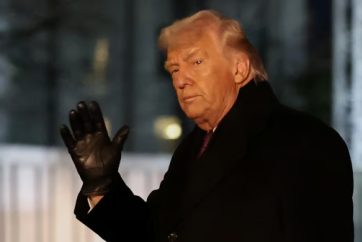
US President Donald Trump has announced that he is withdrawing Canada's invitation to join the Board of Peace initiative created by his administration, which he positions as an international body for conflict resolution. Trump wrote about this in a letter addressed to Canadian Prime Minister Mark Carney.
According to Reuters, Trump's move came after Carney's speech at the World Economic Forum in Davos, where the Canadian prime minister criticized the use of tariffs and “economic integration” as tools of pressure and spoke about the end of the era of “rules-based order.”
Reaction from the parties
Reuters reports that neither Trudeau's office nor the White House immediately responded to the agency's request for comment. In the Ukrainian media, a similar narrative was presented by media outlets that reprinted/retold this news.
Why it looks like an escalation
Reuters notes that Trump had previously publicly countered Carney in Davos, stating that Canada “lives off the United States” and adding “remember that” in his address to the Canadian prime minister. The Guardian, which also described the incident, provided a broader context: Carney insisted that Canada is not dependent on the US, and the topic of financial conditions for participation in the body was also raised (the amount of the contribution for a “permanent seat” was mentioned).
What is the Board of Peace and why was it created?
According to Reuters, the Board of Peace was initially conceived as a mechanism related to the ceasefire in Gaza, and Trump stated that the body would operate “in coordination with the UN” (while specifying that the involvement of the UN would be limited to the framework of the relevant Security Council resolution).
Al Jazeera separately described the launch of the initiative in Davos and the concerns surrounding it regarding the potential “circumvention” or weakening of the UN's role.
Who, according to media reports, has already joined — and who has not
Reuters names Argentina, Bahrain, Morocco, Pakistan, and Turkey among the participating countries, and also notes that a number of US allies (including Britain, France, and Italy) do not yet plan to join. Al Jazeera provides a similar list and logic of “who has joined/who has abstained.”
What this means for US-Canada relations
Symbolically, Trump's decision strikes a blow to public “alliance coordination” and demonstrates that political statements at global forums such as Davos can quickly turn into diplomatic action. In the short term, this increases tensions in relations between Ottawa and Washington and shifts the discussion to “who is with whom in new international formats.”