
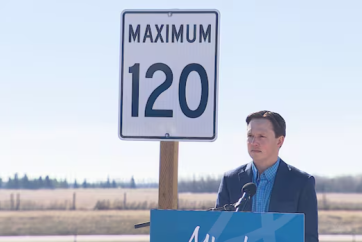
Alberta has officially begun testing a higher speed limit of 120 km/h on a section of Highway 2, also known as the QEII. This highway connects Calgary and Edmonton and is one of the province’s most important transportation arteries.
This does not apply to the entire highway, nor does it mean an automatic speed limit increase across all of Alberta. For now, this is a controlled test on a specific section south of Leduc.
According to the Alberta government, the speed limit has been raised from 110 to 120 km/h on a 22-kilometer stretch of Highway 2 south of the Leduc Commercial Vehicle Inspection Station. The new limit applies in both directions.
Why Alberta Is Testing 120 km/h
Before launching the trial, the Alberta government conducted consultations on a potential speed limit increase on divided highways—that is, highways with separate lanes for each direction of traffic.
According to the survey results, a significant portion of respondents supported the idea of raising the speed limit to 120 km/h on select rural divided highways. Following this, the province decided not to change the rules everywhere at once, but to first launch a controlled mini-trial.
The government’s idea is simple: to see how the higher speed limit works in real-world conditions before making broader decisions for other highways.
Where Exactly Does the New Speed Limit Apply?
The new 120 km/h speed limit is in effect on a section of Highway 2 / QEII south of Leduc.
This is an important clarification, because on social media the news is often presented as if the entire Calgary–Edmonton highway already has the new speed limit. In reality, it applies only to a specific test section.
The government also notes that it will monitor not only the 22-kilometer zone itself but also the adjacent sections of the highway. This is necessary to assess driver behavior, traffic safety, and the potential impact of the new speed limit.
Will 120 km/h become the norm for all of Alberta?
Not yet.
This is a pilot project, not a complete change to the rules for all highways in the province. Based on the results of the observations, the government will assess whether it makes sense to expand this approach to other divided highways.
In other words, it’s important for drivers to rely on actual road signs rather than Facebook posts. If the speed limit on a specific section is set at 110 km/h, that limit remains in effect.
What This Means for Drivers
For drivers, this means that on a specific section of the QEII near Leduc, it is legal to drive 120 km/h if weather conditions, road conditions, traffic, and visibility permit it.
However, the higher speed limit does not override basic safety rules. Even if a sign permits 120 km/h, drivers must still take into account road conditions, following distance, trucks, construction zones, weather conditions, and traffic volume.
This is especially important on the Calgary–Edmonton highway, where there is a lot of commercial traffic, heavy flow, and a variety of driving styles.
Why the News Sparked Debate
As expected, the idea of a 120 km/h speed limit has sparked mixed reactions.
Some drivers support the changes because they believe that on wide, divided highways, many people are already driving at roughly that speed anyway. To them, an official limit of 120 km/h seems more realistic.
Others are concerned that raising the limit could lead to even higher actual speeds, more dangerous passing maneuvers, and more serious consequences in the event of accidents.
That is precisely why the government is calling this a test, rather than a final decision for the entire province.