
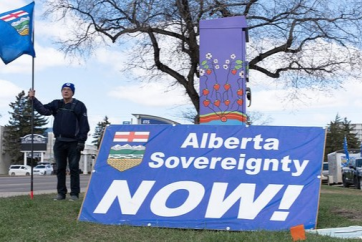
The Alberta Court of Queen’s Bench has overturned a ruling that allowed the provincial independence movement to collect signatures for a potential referendum on Alberta’s secession from Canada. The case concerns the petition titled “A Referendum Relating to Alberta Independence”, which was officially issued in early 2026 by Alberta’s Chief Electoral Officer, Gordon McClure.
The official wording of the question was: “Do you agree that the Province of Alberta should cease to be a part of Canada to become an independent state?” In other words, voters were to be asked whether they agreed that Alberta should cease to be part of Canada and become an independent state.
According to Elections Alberta, the petition was issued on January 2, 2026, and the signature-gathering period was scheduled to run from January 3 to May 2, 2026. For the petition to succeed, 177,732 signatures had to be collected, which is equal to 10% of the votes cast in the previous provincial election.
Organizers from the group Stay Free Alberta stated that they had collected over 300,000 signatures. Reuters reports that there were more than 300,000 signatures, which still had to be verified.
However, Judge Shayna Leonard ruled that the petition should not have been issued because the Alberta government had failed to fulfill its constitutional duty to consult with First Nations. The ruling states that Alberta’s potential secession from Canada could affect treaties with Indigenous peoples, specifically Treaty 7 and Treaty 8.
An official statement from the Blood Tribe notes that the court overturned the decision by the Chief Electoral Officer to issue the petition regarding Alberta’s secession. According to the court, approving such a petition would have set in motion a process that could have led to a referendum and subsequent government action, thereby infringing on the rights of First Nations.
The Blood Tribe also reported that the court found that the Crown knew or should have known that treaty rights could be infringed upon, but no consultations with First Nations were conducted. This was one of the key arguments for overturning the petition.
The case was initiated by representatives of First Nations, specifically the Athabasca Chipewyan First Nation and the Blackfoot Nations, which include the Siksika Nation, Piikani Nation, and Blood Tribe / Kainai. They argued that the referendum process on Alberta’s secession cannot move forward without due consideration of treaty rights.
Alberta Premier Daniel Smith has already stated that the provincial government disagrees with the court’s decision and intends to appeal it.
According to Smith, the government considers the decision “incorrect in law and anti-democratic”.
Despite the dismissal of this particular petition, the issue of Alberta’s independence is unlikely to disappear from the political agenda. Supporters of secession may try to advance the issue through other channels, while the provincial government may seek political or legal avenues for further discussion. At the same time, any attempt to put such a question to a vote without consulting First Nations will most likely face legal challenges again.
Thus, the court ruling has become a major obstacle for the separatist movement in Alberta. It not only halted this specific petition but also served as a reminder that the question of the province’s potential secession from Canada cannot be treated as a routine political initiative. Due to treaty rights and the Crown’s constitutional obligations, such a process directly affects First Nations, whose treaties with the Crown predate the very creation of the province of Alberta.