
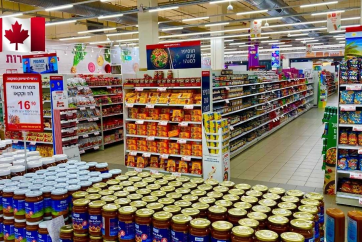
The Canadian government has unveiled a sweeping plan designed to make food more affordable, boost competition among retailers, and reduce the country’s reliance on imports.
On June 11, 2026, Prime Minister Mark Carney announced the launch of Canada’s first-ever National Food Security Strategy. Over the next ten years, more than $3 billion is planned to be allocated for its implementation.
The strategy’s goal is not to temporarily lower prices in supermarkets, but to transform the very system of growing, processing, transporting, and selling food in Canada.
Why the government decided to intervene
Canada is one of the world’s largest producers and exporters of agricultural products. At the same time, Canadians continue to pay some of the highest food prices among G7 countries.
Following the pandemic, food costs have risen significantly. Prices are influenced by international conflicts, tariffs, climate change, crop failures, and rising costs of fuel, fertilizers, and transportation.
However, the government acknowledges that the problem lies not only in global events. Within Canada, there is also a lack of competition, processing plants, cold storage facilities, regional distributors, and alternative food supply channels.
The five largest grocery chains—Loblaw, Sobeys, Metro, Walmart, and Costco—control about 75% of Canada’s grocery retail market. As a result, small independent stores find it difficult to compete with large companies.
Some small stores are forced to purchase goods through supply chains owned by their very own large competitors. As a result, they pay additional markups and are not always able to offer customers lower prices.
One Billion Dollars for Grocery Terminals and Logistics
One of the key components of the strategy will be the new ten-year Food-Link fund, worth $1 billion.
The funds are planned to be directed toward the construction and expansion of food terminals, logistics centers, cold storage facilities, and transportation infrastructure.
Food terminals are large wholesale hubs where farmers, producers, stores, restaurants, and other buyers can do business directly. This will allow independent stores to purchase produce without going through large retail chains.
In Canada, the Ontario Food Terminal in Toronto is already operational. Nearly 2 billion pounds of fruits and vegetables pass through it annually, and approximately 5,000 registered buyers use its services.
The government is considering expanding this terminal and creating similar facilities in other parts of the country.
There are also plans to open 20 to 40 smaller food hubs. These hubs are intended to consolidate produce from various local farmers, ensure its storage, and facilitate delivery to stores, restaurants, hospitals, schools, and other institutions.
Such centers could be particularly important for rural, remote, and northern communities, where food is often more expensive due to long distances and complex logistics.
More Competition Among Grocery Chains
The government plans to allocate nearly $130 million to strengthen the work of the Competition Bureau and the Competition Tribunal.
These agencies should more actively investigate anti-competitive practices and actions by companies that may restrict the opening of new grocery stores.
One issue is special clauses in commercial real estate lease agreements. Large chains can sometimes negotiate clauses prohibiting the opening of other grocery stores nearby or restricting the sale of certain product categories within the same shopping center.
Such clauses make it harder for new companies to enter the market and reduce choice for shoppers.
One Billion Dollars for Food Processing in Canada
Another major initiative will be the creation of the Agri-food Project Finance Fund, with a budget of $1 billion.
The fund will operate through Farm Credit Canada and provide financing to businesses looking to build or expand food processing plants.
The issue is that Canada produces a lot of agricultural products, but some of them are exported to other countries for processing. Afterward, the finished products can be returned to Canada at a higher price.
The government wants more Canadian grain, meat, vegetables, fruits, fish, and other products to be processed directly in Canada. This is expected to create new jobs, reduce transportation costs, and make the food system less dependent on other countries.
Separately, $150 million is earmarked for small and medium-sized enterprises that want to upgrade their equipment and increase production volumes.
Another $100 million is planned to be allocated to innovative projects in the food processing sector.
Year-Round Fruits and Vegetables
Canada relies heavily on imported fruits and vegetables, especially in the winter. To change this, the government plans to invest $750 million over seven years in greenhouses, vertical farms, and other indoor growing systems.
Most of the funds will go toward new technologies: automation, robotic systems, modern lighting, and digital tools for monitoring growing conditions.
This should help Canadian producers reduce energy and labor costs, as well as grow more vegetables, greens, berries, and other crops year-round.
A separate $100 million is earmarked for developing local food production in rural and northern communities.
By 2032, the government aims to double the value of produce grown in controlled environments—from $774 million to $1.55 billion.
Faster Approval of Seeds, Fertilizers, and Veterinary Drugs
The strategy also aims to reduce administrative barriers for farmers and producers.
The government plans to expedite the review of applications for new seeds, feed, fertilizers, and veterinary drugs. $11.3 million over four years is being allocated to reduce backlogs and modernize processes.
The government also wants to help businesses with provincial licenses more easily enter the national market.
Currently, a product manufactured and approved for sale in one province cannot always be easily sold in another. The government believes that simplifying these rules will increase choice and competition.
What this means for Canadians
For consumers, the strategy could potentially mean a wider selection of local products, the emergence of new independent stores, better access to fresh fruits and vegetables, and less reliance on imports.
For farmers, this is an opportunity to sell their products to a larger number of buyers and not depend solely on large chains and processors.
For small grocery stores, it’s a chance to access alternative supply chains, shared warehouses, refrigeration, and transportation.
The government has set a goal: to increase the share of healthy, Canadian-produced foods available to residents from 75% to 85% by 2032.
Whether Canadians will see this reflected in their weekly grocery bills will only become clear once the new funds and programs begin to take effect.