
Early voting has begun in Alberta for a provincial referendum that has already attracted significant attention from Canadians. This time, voters are being asked to answer ten questions at once regarding immigration, the province’s constitutional powers, and even Alberta’s possible secession from Canada.
Voting began on October 13, 2026 and will continue through October 17. The main day of the referendum is scheduled for Monday, October 19.
For many Ukrainians living in Calgary, Edmonton, and other cities in Alberta, this referendum is also of interest. Some of the questions directly concern immigration policy, access to public services, and the rights of people with temporary status in Canada.
Here’s what’s happening, who is eligible to vote, and what you should pay attention to.
When Can You Vote?
According to Elections Alberta, early voting takes place over five days—from October 13 to 17.
The main referendum day is October 19, 2026.
On referendum day, polling places will be open from 9:00 a.m. to 8:00 p.m.
During early voting, hours may vary by polling place, so be sure to check the current schedule before visiting.
It’s important to note that during early voting, voters can visit any available polling place within their electoral district.
However, on October 19, you must vote at the polling place assigned to your residential address.
You can find your polling place through the official Elections Alberta service:
What Questions Are on the Referendum Ballot
This year, Albertans are being asked to answer ten questions.
Nine of them call for a “Yes” or “No” answer. They concern immigration policy and changes to the province’s constitutional powers.
The tenth question has two separate answer options and concerns Alberta’s future as part of Canada.
Immigration and Access to Public Services
Five questions focus on immigration and the rules for accessing provincially funded programs.
Specifically, voters are asked whether they support:
- expanding Alberta’s authority in the area of immigration;
- giving priority to provincial residents in employment;
- introducing additional immigration status requirements for access to public programs;
- establishing a 12-month residency period for people with temporary immigration status to receive certain types of social assistance;
- the introduction of certain fees for health care and educational services for people with temporary status;
- mandatory verification of Canadian citizenship when voting in provincial elections.
These issues may be of particular interest to Ukrainians in Canada under temporary programs, particularly those with open work permits.
However, it is important to understand that the mere fact that a referendum is being held does not mean that these rules have already been implemented.
These are proposals on which the government wants to gauge voters’ views. Any subsequent legislative changes will require separate decisions.
Alberta’s Constitutional Powers
Four more questions concern the relationship between provincial and federal authorities.
Among them are the possibility of expanding provincial influence over the appointment of judges, abolishing the federal Senate, changing the rules for provincial participation in federal programs, and strengthening the priority of provincial legislation in certain areas.
Implementing these proposals may require amendments to the Canadian Constitution, which Alberta cannot enact on its own.
Will Voters Vote for Alberta’s Independence?
The tenth question, in particular, has sparked the most debate.
Voters are asked to choose one of two options:
Option One: Alberta should remain a province of Canada.
Option 2: The Alberta government should initiate the legal process provided for in the Canadian Constitution to hold a separate, binding referendum on the province’s potential secession.
There is an important nuance here.
On October 19, Albertans will not be voting directly on leaving Canada.
Even if a majority supports the second option, this will not mean an automatic declaration of independence.
The result will concern the question of initiating a legal process that could potentially lead to a subsequent referendum.
Furthermore, the result of the vote on October 19 is not legally binding.
Who Is Eligible to Vote
Alberta residents who meet the following three basic requirements may participate in the referendum:
- are Canadian citizens;
- are 18 years of age as of October 19, 2026;
- are permanent residents of Alberta as defined by election law.
This means that Ukrainians in Canada under the CUAET program, who hold a Work Permit, Study Permit, or even Permanent Resident status, cannot vote unless they have already obtained Canadian citizenship.
At the same time, Canadian citizens of Ukrainian descent who meet these requirements may vote.
What Documents Are Required
To vote, you must verify your identity and residential address.
The simplest option is to present a single government-issued document with a photo, your full name, and your current residential address.
For example, this could be an Alberta Driver’s License or an Alberta Identification Card.
If you do not have such a document, you may use two documents that together verify the required information.
Both must include the voter’s name, and at least one must include a current residential address.
In some cases, you may use other methods of identification permitted by the rules.
A complete list of acceptable documents is published on the Elections Alberta website.
Important: The Where to Vote card, which voters receive by mail, helps you find your polling place but is not, in itself, a form of identification.
What to Do If You Are Not Registered to Vote
If a person has previously voted in a provincial election, has not changed their address, and has not updated their personal information, they are most likely already on the voter list.
However, not being pre-registered does not mean you cannot vote.
Elections Alberta allows voters who meet the established requirements to register directly at the polling place.
To do so, you must provide the necessary documents and confirm your eligibility to vote.
Can you vote by mail?
Yes, but the deadline for submitting new applications for special mail-in ballots has already passed.
The deadline for submitting applications was September 25, 2026.
Those who previously requested a special ballot must ensure that Elections Alberta receives it by 5:00 p.m. on October 16.
The date of receipt is what matters, not the date of mailing.
If you requested a mail-in ballot but have decided to vote in person, you may do so provided your vote has not yet been counted.
You do not need to bring your unused mail-in ballot to the polling place.
If you vote in person and your mail-in ballot arrives later, your second vote will not be counted.
Can I take time off work to vote?
Yes. Alberta’s election laws provide employees with the right to time off to vote.
A voter must have at least three consecutive hours off from work during polling hours on one of the voting days.
If the work schedule does not allow for these three hours, the employer is required to provide additional time.
The employer may determine when to grant this time—during early voting or on the main day of the referendum.
The additional time that the employer is required to provide for voting is paid.
However, this right applies only to employees who are eligible to vote and have not yet exercised that right.
How Voting Will Take Place
This time, the procedure will differ slightly from regular elections.
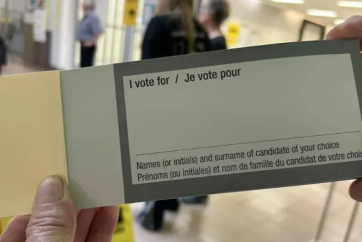
Each voter will receive ten separate ballots of different colors—one for each question.
The first nine allow for answers of “Yes” or “No”.
On the tenth ballot, voters will need to choose one of two options regarding Alberta’s future as part of Canada.
If a voter does not wish to answer a particular question, they may choose not to use that ballot.
After filling out the ballots, voters must deposit them in the appropriate ballot boxes.
Organizers recommend reviewing all the questions in advance to avoid wasting time at the polling station.
When Will the Results Be Announced?
Main voting will end on October 19 at 8:00 p.m.
Votes will be counted by hand.
The tenth question, concerning Alberta’s future as part of Canada, will be counted first.
Preliminary results will be published as the count is completed. According to Elections Alberta rules, the unofficial count of all ten questions must be completed within 48 hours after the polls close.
The official results are scheduled to be announced on October 29, 2026.
What This Means for Ukrainians in Alberta
For the Ukrainian communities in Calgary, Edmonton, and other cities across the province, this referendum is important not only because of the question of Alberta’s possible secession from Canada.
Special attention should be paid to the section on immigration.
Among the proposed changes are issues regarding access to social programs, healthcare, and educational services for people with temporary status.
That is why Ukrainians who work or study in Alberta should keep an eye on the provincial government’s future decisions.
At the same time, it is important not to confuse the referendum results with laws that have already been passed.
None of the questions put to a vote on its own changes a person’s immigration status, revokes a valid work permit, or automatically imposes new restrictions.
The referendum is advisory in nature, and any potential future changes will require separate legal procedures.
Where to Find Official Information
All current information about voting, polling places, required documents, and results can be found on the official Elections Alberta website.
All ten referendum questions are also published there in their original wording.
If you are eligible to vote, you should check your polling place in advance, prepare your documents, and familiarize yourself with the questions.
For those who do not yet have Canadian citizenship, it is important to closely follow the results and subsequent decisions by the authorities, especially regarding immigration policy and public services.
The referendum on October 19 will not change Alberta’s laws overnight, but its results may influence the direction of future political and legislative discussions in the province.