
A Work Permit is a document that gives a foreigner the right to work legally in Canada. Without it, working is prohibited, and violations can lead to deportation and a ban on entry. Below is everything a Ukrainian in Calgary needs to know: from types of permits to step-by-step application and passport details.
Types of Work Permits in Canada
There are two main types of work permits in Canada:
Open Work Permit
Allows you to work for any employer in Canada (with rare exceptions). You do not need to have a specific job offer or LMIA.
Who can get an open permit:
- Ukrainians who arrived under the CUAET program before March 31, 2024
- Graduates of Canadian educational institutions (Post-Graduation Work Permit, PGWP)
- Spouses/common-law partners of skilled workers or students
- Permanent residence applicants (Bridging Open Work Permit)
- Participants in the International Experience Canada (IEC) — Working Holiday program
Employer-Specific Work Permit (permit tied to an employer)
Allows you to work only for a specific employer, in a specific position, and in a specific location. Usually requires the employer to obtain an LMIA (Labour Market Impact Assessment) in advance.
| Parameter | Open Work Permit | Employer-Specific Work Permit |
|---|---|---|
| Employer | Any | Specific, specified in the permit |
| Job offer required | No | Yes |
| LMIA | Not required | Usually required |
| Flexibility | High | Low |
| For whom | CUAET, PGWP, spouses, IEC, etc. | Employees with a job offer |
CUAET program for Ukrainians: what you need to know
Canada-Ukraine Authorization for Emergency Travel (CUAET) is a special program of the Canadian government to support Ukrainians fleeing the war. Since its launch, about 300,000 people have taken advantage of it.
Who is eligible for an extension: Ukrainians and their family members who arrived in Canada before March 31, 2024, under the CUAET program and have valid temporary status.
What you can get:
- A new Open Work Permit for up to 3 years (depending on the validity of your passport)
- An extension of your existing Open Work Permit
- Study Permit
- Extension of temporary resident status (visitor record)
Application deadline: March 31, 2026 — the deadline for submitting an application. If you apply later, you will have to apply through regular programs, where the conditions are much more complicated.
Passport nuance: Many Ukrainians face the problem of passport expiration. The Canadian government officially allows you to apply even if your passport has not yet been renewed — each case is considered individually. However, the new permit will be issued for a maximum of the passport's validity period, so it is advisable to renew your passport as soon as possible and then add a new copy to your application via the IRCC web form.
Fees for a Work Permit in 2026
All fees are paid online through the IRCC portal when submitting the application:
| Fee | Amount (CAD) |
|---|---|
| Work Permit application (including renewal) | 155 |
| Additional fee for Open Work Permit | 100 |
| Biometrics (fingerprints + photo) | 85 (per person) or 170 (per family of 2 or more) |
| Status renewal + new Work Permit | 401.25 |
| Medical examination (approximately) | 200–400 (depending on the clinic) |
For an open permit, the total amount will be 155 + 100 = 255 CAD plus biometrics 85 CAD if you are applying for the first time. Total — about 340 CAD.
Starting January 10, 2026, Canada has introduced a new work license system to replace the Open Work Permit, with a mandatory fee of $230 CAD. Some sources also indicate a total amount of $410 CAD ($255 OWP fee + $155 processing fee) for new Open Work Permit applications in 2026.
Processing times in 2026
| Application type | Estimated processing time |
|---|---|
| Open Work Permit (from within Canada, spouse/PGWP) | 241 days (as of January 2026) |
| Work Permit Renewal (from within Canada) | 241 days (as of January 28, 2026) |
| Employer-Specific Work Permit | 8–24 weeks (depending on LMIA) |
| Application from outside Canada | ~21 weeks |
| CUAET renewal | ~182 days (as of mid-2025) |
| Global Talent Stream (tech professionals) | ~2 weeks |
Important: A medical examination can add another 3+ months to the total processing time, so apply as early as possible.
Step-by-step instructions: how to apply for a Work Permit from Calgary
Step 1: Determine the type of permit
- If you arrived under CUAET before March 31, 2024 → apply for an Open Work Permit under the simplified procedure
- If you have a job offer from a Canadian employer → you need an Employer-Specific Work Permit (the employer must first obtain an LMIA)
- If you are a graduate of a Canadian institution in Alberta → PGWP
Step 2: Gather your documents
- Valid foreign passport (for CUAET, you can apply with an expired passport, but it is better to renew it)
- Completed online form via the IRCC Portal
- Photo in accordance with Canadian requirements
- Confirmation of job offer (job offer letter, LMIA number) — for employer-specific
- Education documents (diplomas, certificates, transcripts)
- Proof of work experience (letters of recommendation)
- Police clearance certificate — from each country where you have lived for more than 6 months after the age of 18
- Medical examination by an IRCC-accredited panel physician (if required)
- Biometrics (fingerprints and photo)
- Proof of CUAET status — for those applying under the CUAET program
- Letter of explanation — it is recommended to describe your situation
Step 3: Create an IRCC account and complete the online application
- Go to the IRCC website and log in or create an account
- Complete the online questionnaire — the system will automatically generate a personalized checklist of documents
- Complete all the necessary forms directly in your account
- Upload all documents according to the checklist
Step 4: Pay the fees
Payment is made online through the IRCC portal by credit or debit card. Make sure you have paid all the necessary fees (work permit fee + open work permit fee + biometrics fee).
Step 5: Submit your application
After uploading all documents and paying, click “Submit.” The system will not allow you to submit your application if any required documents are missing.
Step 6: Submit your biometrics (if required)
After submitting your application, you will receive a biometric instruction letter in your IRCC account. You will then have 30 days to submit your biometrics.
Video instructions: https://www.youtube.com/watch?v=MBcBzk2UP0w&t=2s
How to fill out the IMM 5710 form: step-by-step instructions with visuals
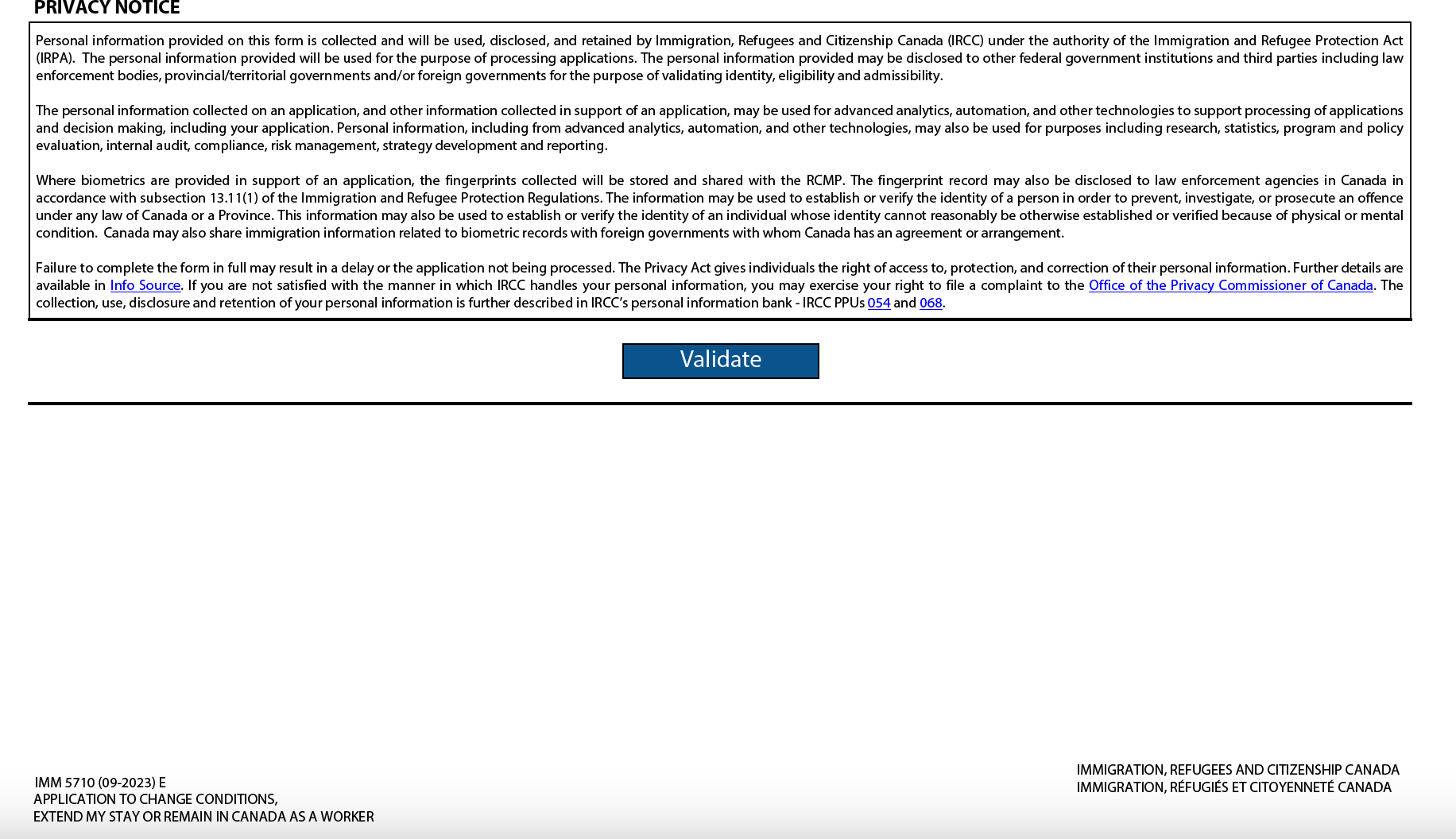
IRCC clearly states: it is better to fill out the form on a computer, answer all questions, and for paper submissions, validate the form to generate a barcode page.
Below is an example of the IMM 5710 form:
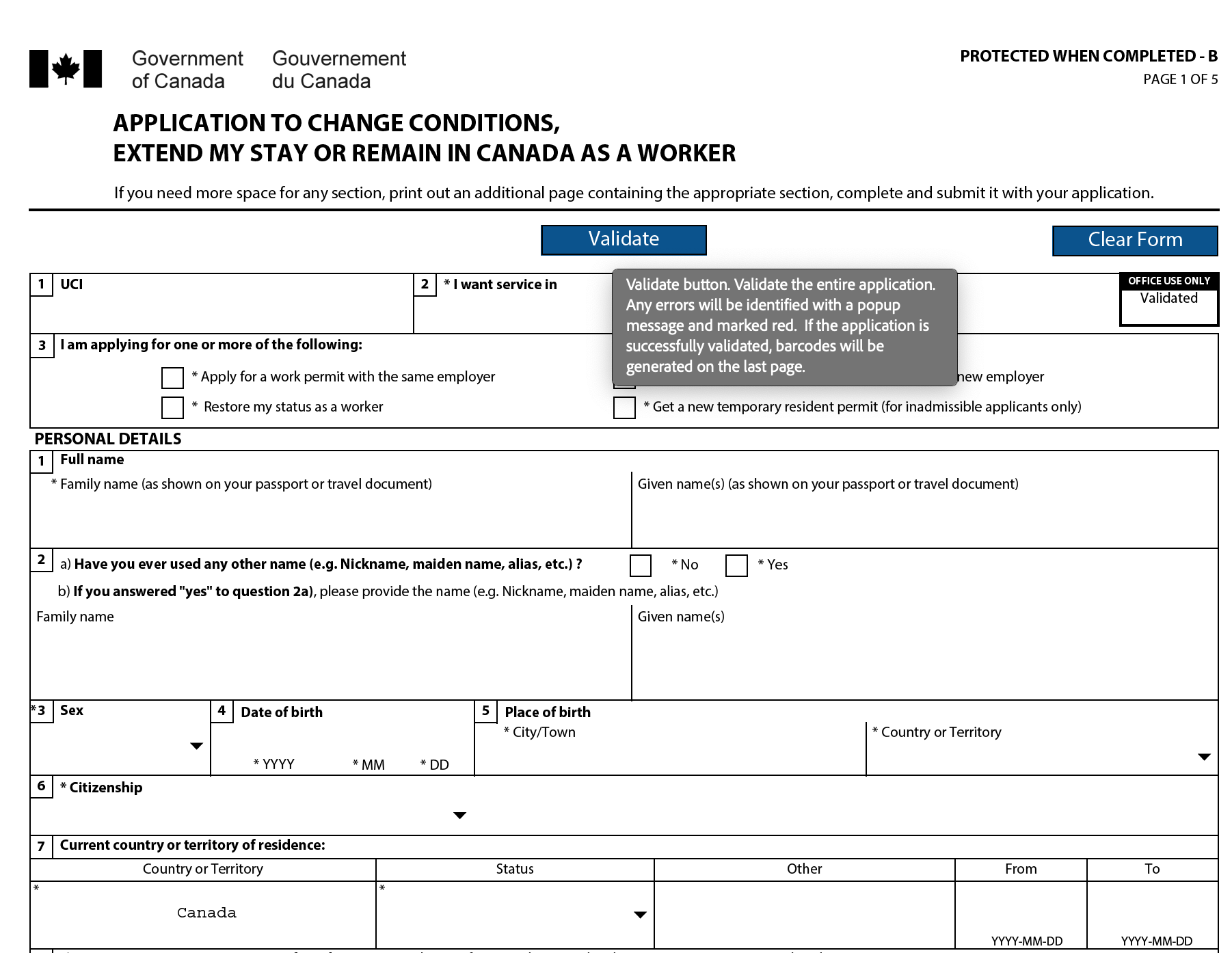
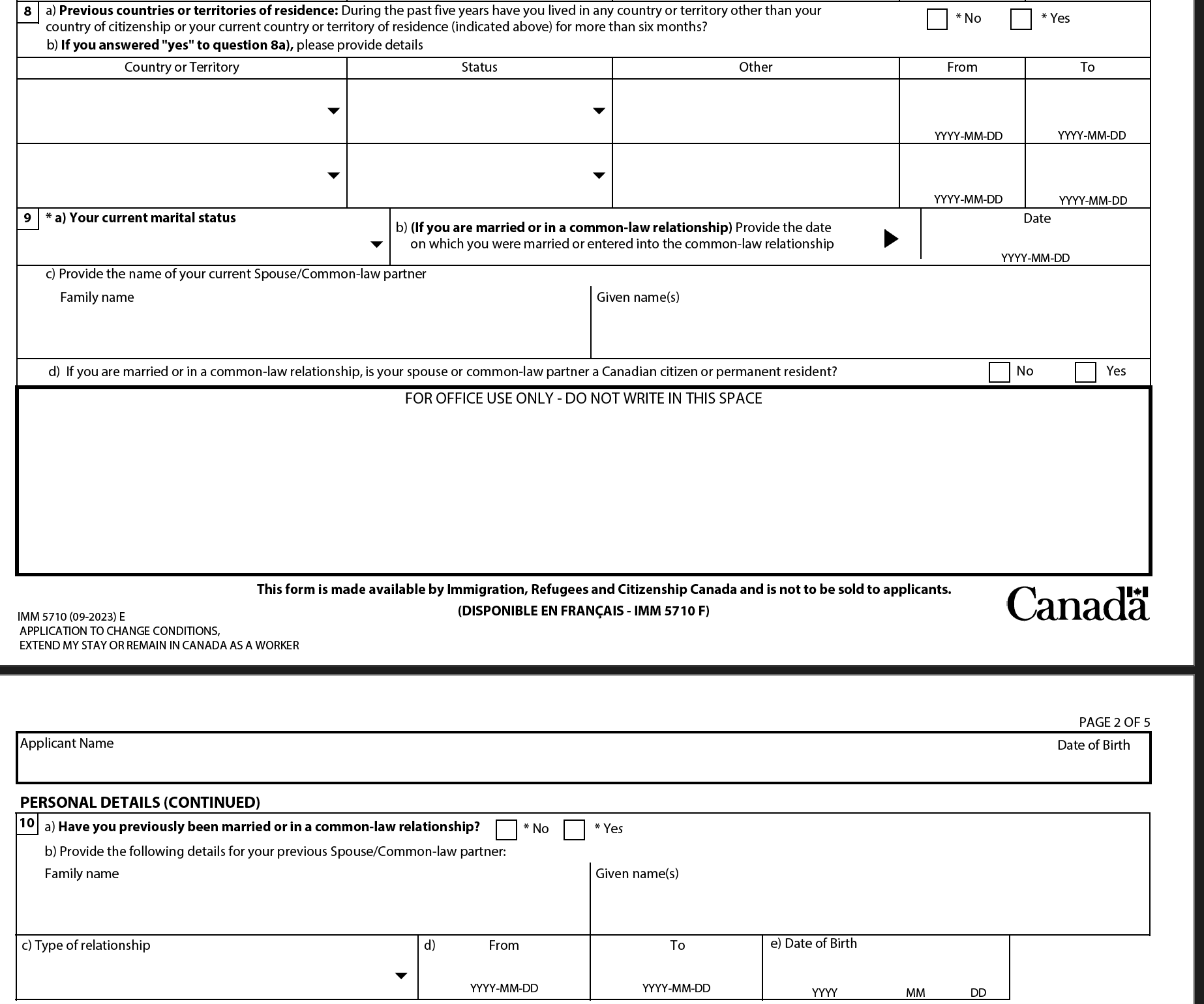
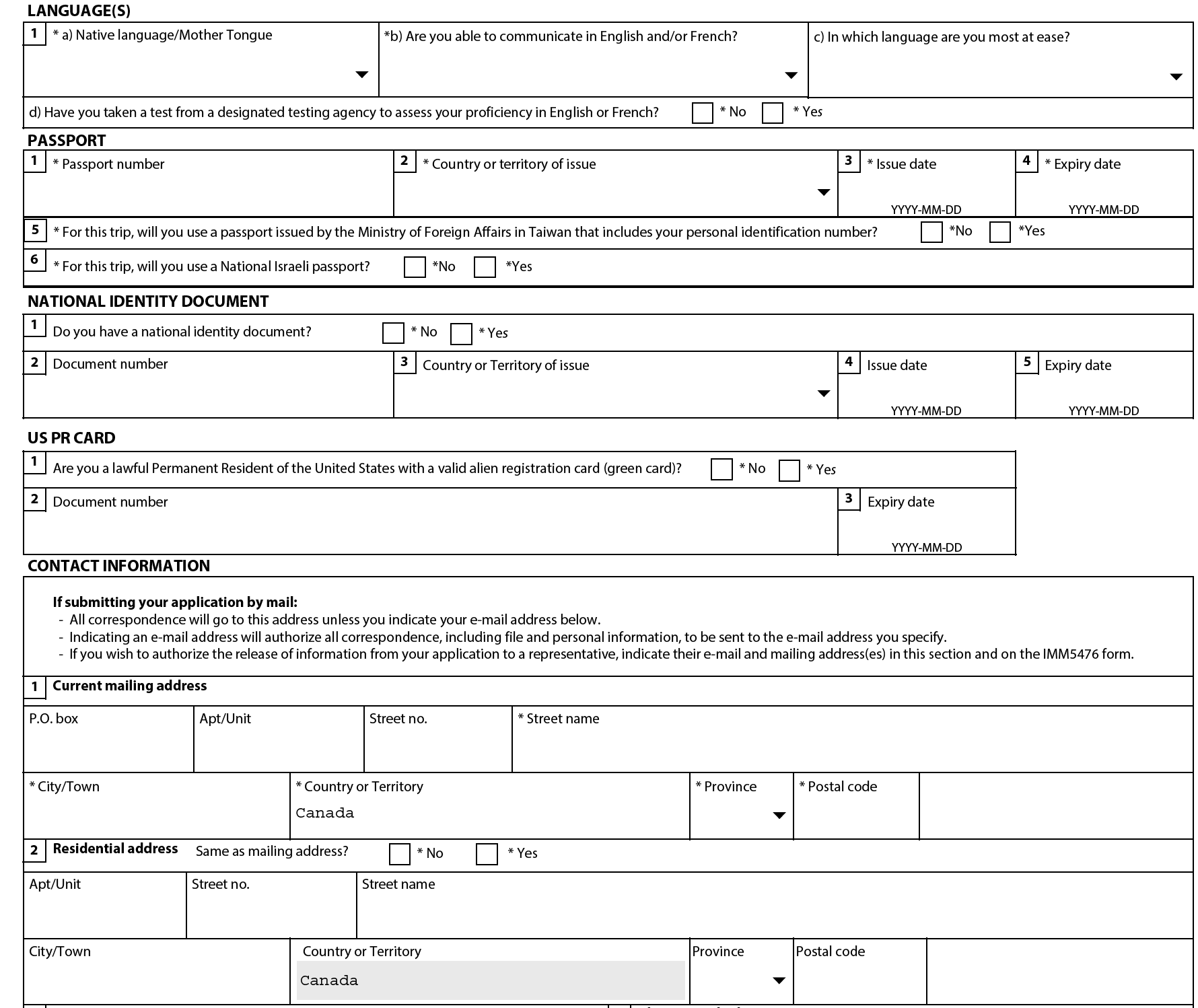
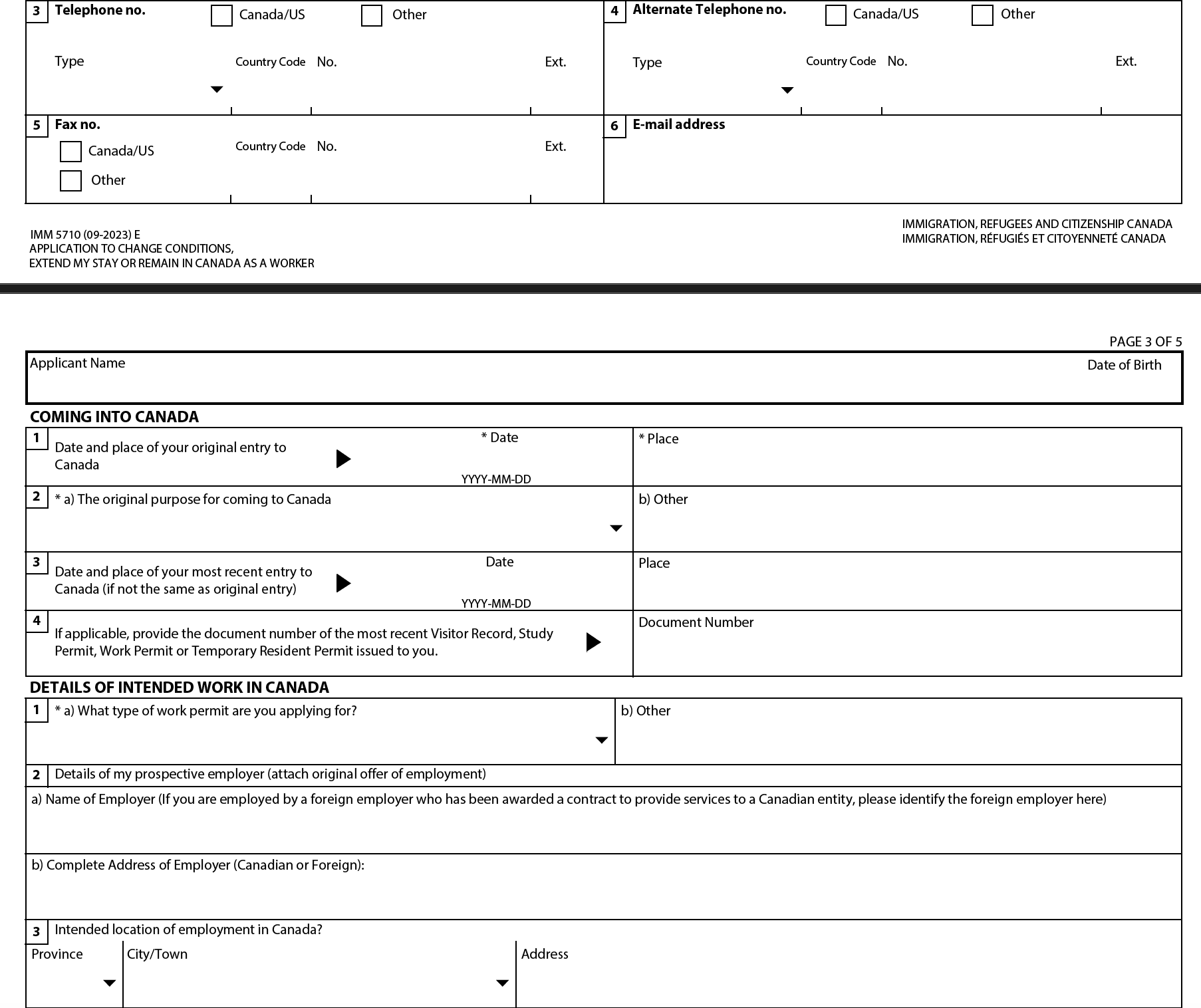
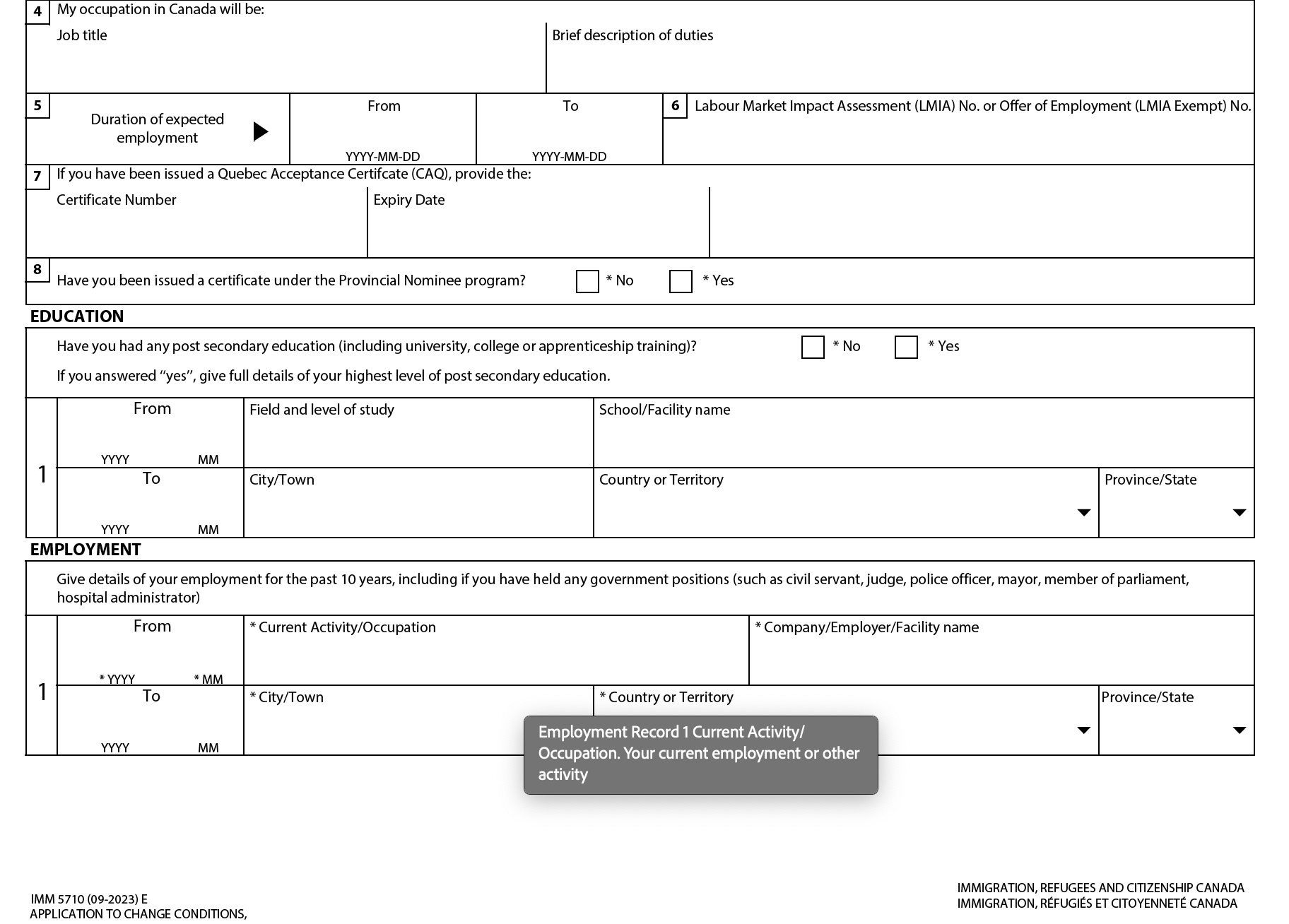
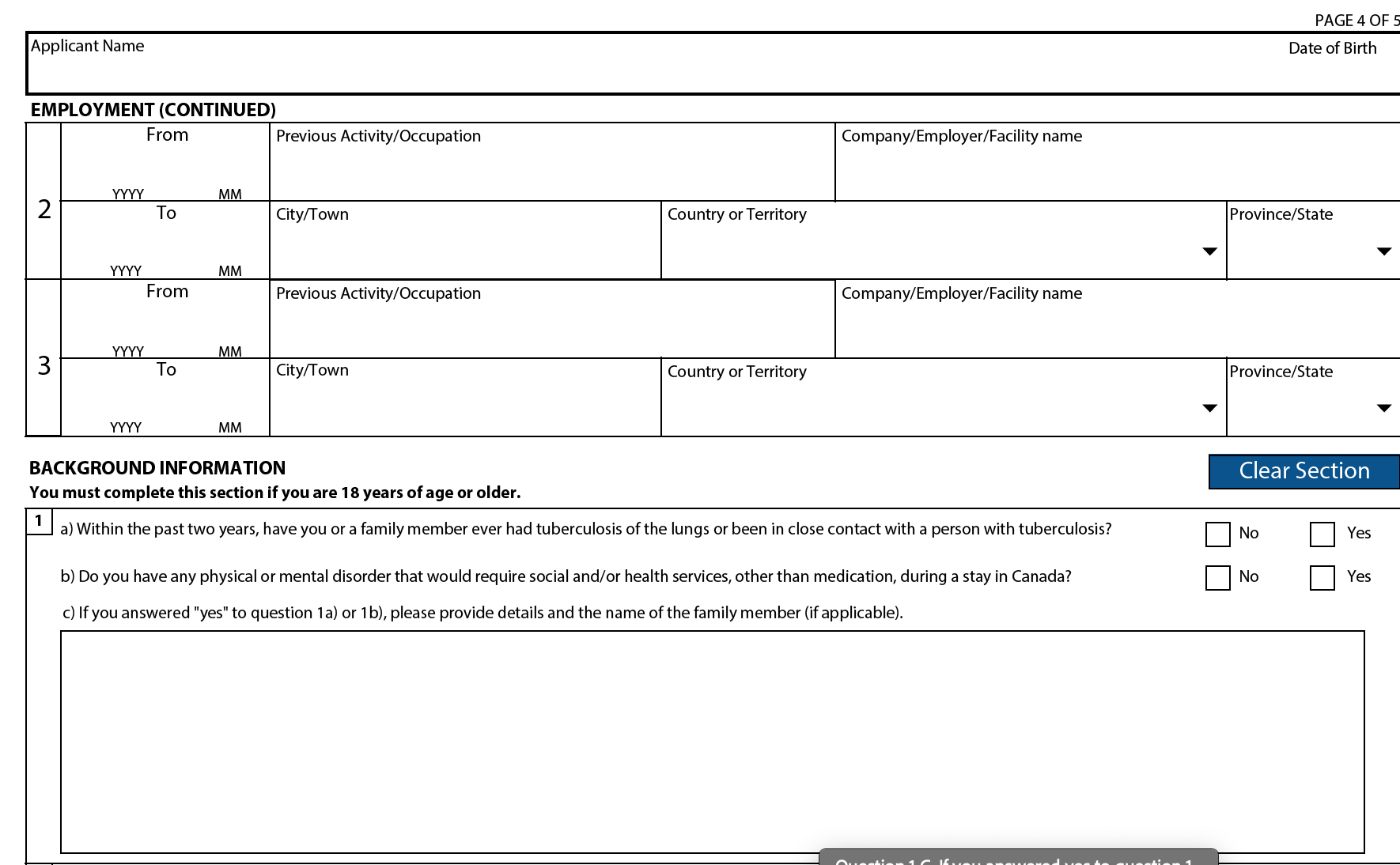
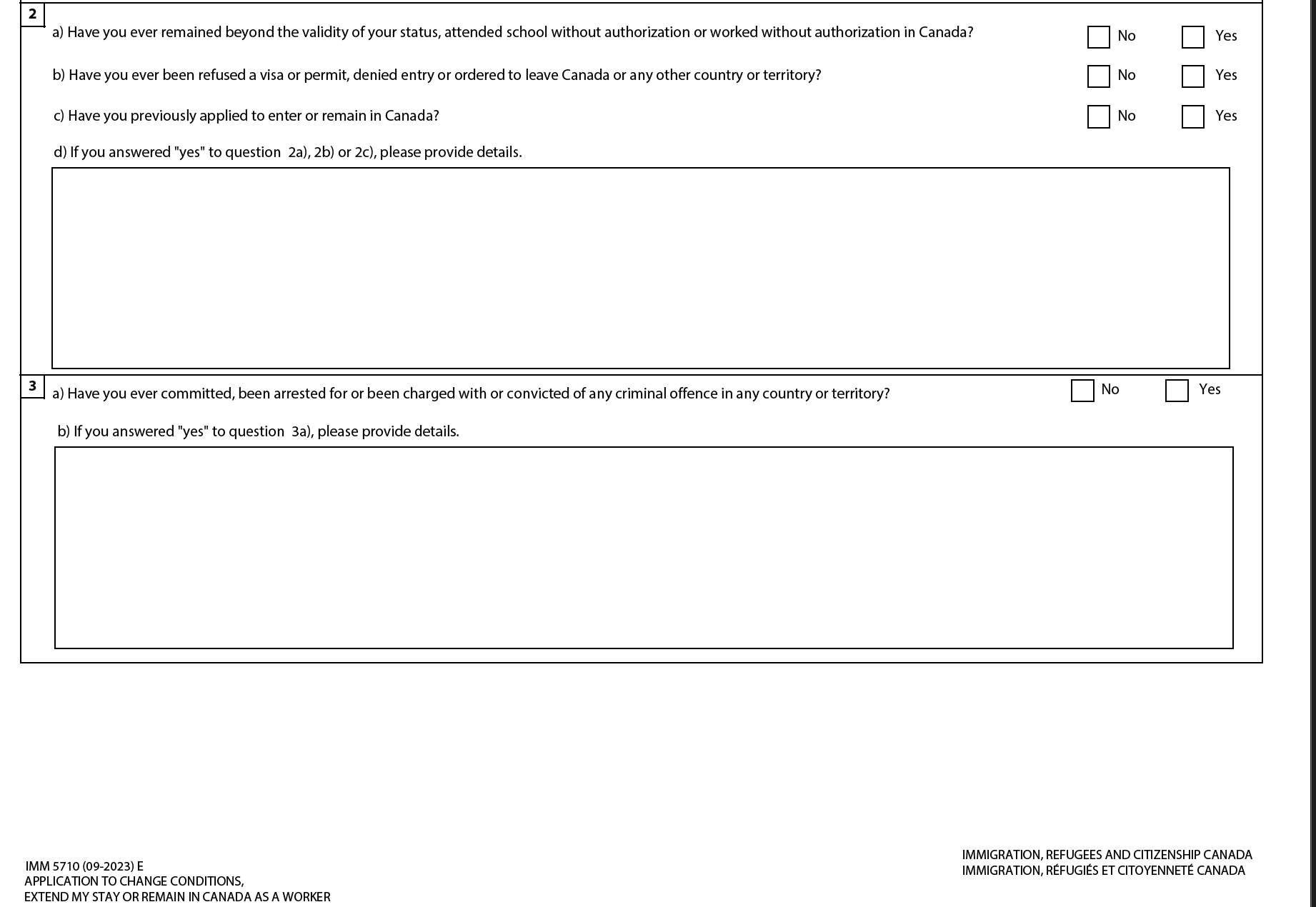
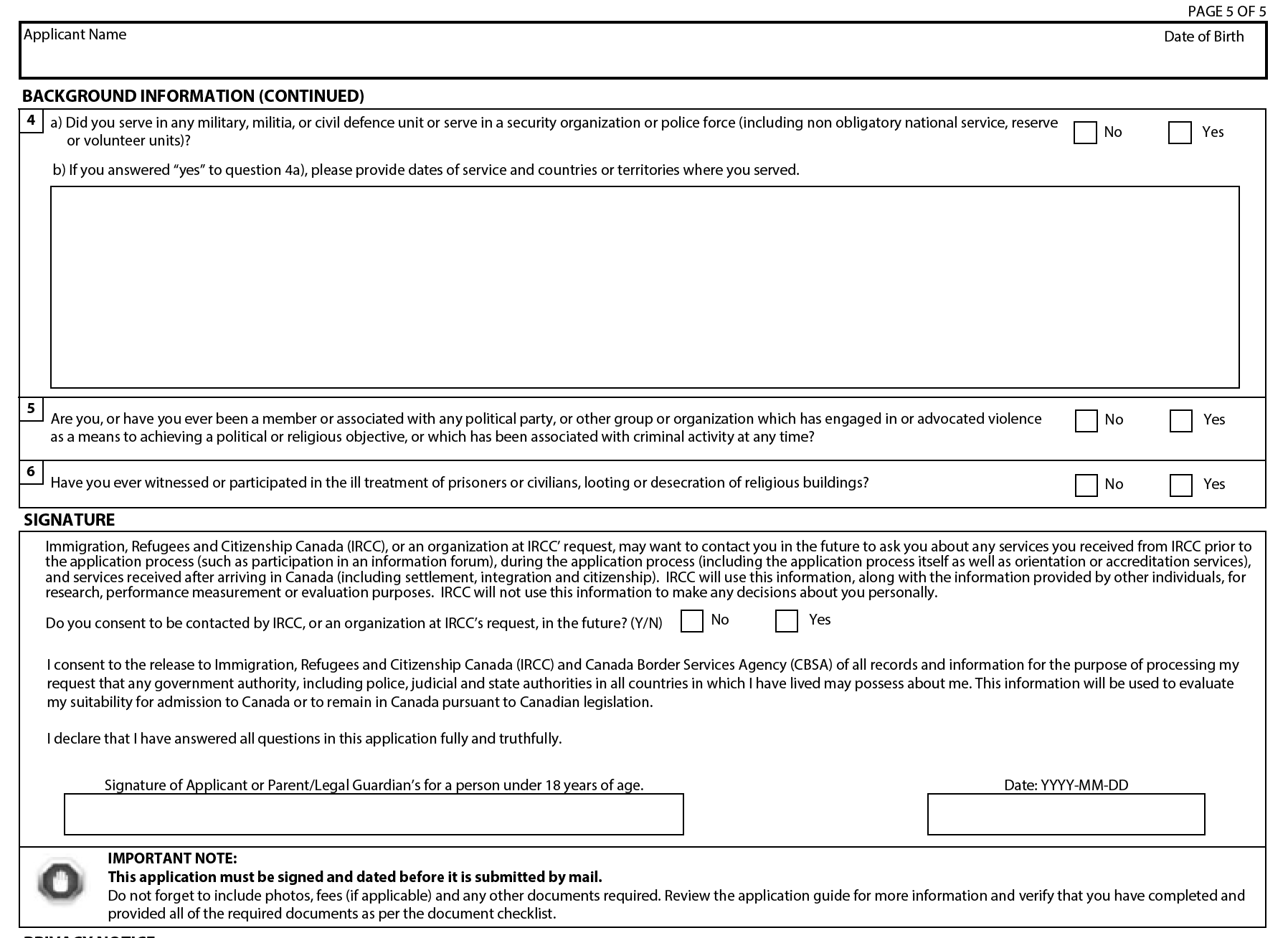
Page 1: Sections A and B (Identifying Information / Personal Details)
In the first part of the form, you need to enter your personal information.
- Leave the UCI field blank if you are applying to IRCC for the first time (you do not yet have a client number).
- Indicate your language of communication — English or French; English is used in the example.
- Enter your last name (Family Name) and first name(s) (Given Name(s)) exactly as they appear in your foreign passport, for example: KOVALENKO OLEKSANDR.
- If you have never used other names (maiden name, after marriage, etc.), select No in the Other names used? field.
- For Gender, select the letter that corresponds to your document: M (male), F (female), or X/U for other options.
- Date of birth format — YYYY-MM-DD (for example, 1990-05-15).
- Fill in the city and country of birth as in your passport, for example KYIV, UKRAINE.
- In the Citizenship and Country of Residence fields, enter UKRAINE and CANADA (if you currently reside in Canada), respectively.
- Status in Canada — Worker, Student, Visitor, or other, depending on your situation.
- For the From–To field for residence in Canada, you can enter 2022-07-10 – Present.
- In the Marital Status section, select your current status, for example, Single.
Page 2: Sections C and D (Passport / Contact Information / Intended Work)
Here you enter your passport and contact details, as well as the type of work permit.
- In the Passport Number field, enter your foreign passport number without spaces (for example, FT123456).
- Country of Issue — UKRAINE, date of issue 2021-03-20, expiration date 2031-03-20.
- The mailing address must be complete, for example, Apt 204, 512 17th Avenue SW, Calgary, AB, T2S 0A5.
- Provide your Email and Phone (with international code, for example, +1 403 555 0147). IRCC only sends emails from the domains @cic.gc.ca, @canada.ca, or @international.gc.ca.
- In the Type of Work Permit Requested field, select Open Work Permit.
- Important: if you are applying for an Open Work Permit, leave questions 2–6 in section D (employer, position, LMIA, etc.) blank. Filling in these fields is a common mistake.
Page 3: Sections E and F (Education / Employment / Background Information)
This section describes the applicant's education, employment, and a brief background check.
- If you have post-secondary education, select Yes in the Post-secondary education? field.
- Highest level — Bachelor’s degree.
- Education: 2008-09 – 2012-06, major Computer Science, educational institution Taras Shevchenko National University of Kyiv, city Kyiv, Ukraine.
- Current job: 2022-08 – Present, Software Developer, Tech Solutions Calgary Inc., Calgary, AB, Canada.
- Previous employment (last 10 years): March 2016 – June 2022, Junior Developer, Digital Agency Kyiv LLC, Kyiv, Ukraine.
- In the Background Information (Q1–Q6) section, answer No to all questions unless you have had health problems, criminal offenses, visa refusals, etc.
Note: If even one question in section F is left unanswered, the application will be considered incomplete and returned without consideration.
Common mistakes when filling out the form
- The name or date of birth does not match the passport.
- Dates are entered in the wrong format (IRCC requires YYYY-MM-DD).
- Questions 2–6 are filled out for Open Work Permit.
- Form validation is not completed (barcode page is missing).
- Additional fee of $100 for Open Work Permit is not paid.
Where to submit biometrics in Calgary
Biometrics in Canada are collected by Service Canada offices. There are several locations in Calgary, all open Monday through Friday from 8:30 a.m. to 4:00 p.m. (walk-in):
| Office name | Address |
|---|---|
| Calgary Temple Crossing Service Canada | Suite 116, 5401 Temple Drive NE |
| Calgary Sundance Service Canada | 120-23 Sunpark Drive SE |
| Calgary Centre (Harry Hays Building) | Suite 150, 220 4th Avenue SE |
| Calgary Royal Vista Service Canada | Suite 350, 15 Royal Vista Place NW |
You can also register online through the Service Canada portal. Biometrics submitted for temporary resident status are valid for 10 years and are used for subsequent applications.
Maintained Status: what it is and why it is critical
If you have applied to extend your Work Permit before your current permit expires, you automatically receive maintained status (formerly implied status):
- You can continue to work under the same conditions until IRCC makes a decision
- Your SIN remains valid
- You are legally in Canada
What you CANNOT do on maintained status:
- Leave Canada — if you leave the country after your permit expires, you will lose your status and the right to work
- Work under different conditions (for example, if you applied for a study permit instead of a work permit, you cannot work)
What to do if you missed the deadline: if your work permit has already expired and you did not submit your application on time, there is a 90-day window for restoration of status. However, you cannot work during this period. Fee: CAD 246.25 + CAD 155 = CAD 401.25.
LMIA: if you have a job offer from an employer in Calgary
If you are not eligible for CUAET or want to obtain an employer-specific work permit, your employer must first go through the LMIA procedure:
- The employer submits an application to Employment and Social Development Canada (ESDC)
- The employer must prove that they tried to hire a Canadian/resident but did not find a suitable candidate (minimum 4 weeks of recruitment)
- After receiving a positive LMIA, the employer sends you a job offer with the LMIA number
- You apply for a Work Permit online through IRCC, attaching the LMIA and job offer
LMIA processing time: usually 5–10 weeks. For tech specialists through the Global Talent Stream — approximately 2 weeks.
LMIA-exempt categories (without LMIA)
- Intra-company transfers
- International Experience Canada (IEC) — Working Holiday, Young Professionals
- International trade agreements (CUSMA/USMCA, CETA)
- Global Talent Stream (for certain categories)
- Francophone Mobility
- Open Work Permits under the CUAET program
Path to permanent residency: Alberta PNP
A Work Permit is a temporary status. However, it is possible to transition to permanent residency (PR) through Alberta's provincial program, the Alberta Advantage Immigration Program (AAIP).
Alberta Opportunity Stream
For those already working in Alberta with a valid Work Permit:
- Minimum of 1 year of work experience in Alberta in the last 18 months OR 2 years of experience in the last 30 months
- Valid job offer in Alberta for full-time work for a minimum of 1 year
- Language level: CLB 5 for NOC TEER 0–3, CLB 4 for NOC TEER 4–5
- An Open Work Permit for Ukrainians under CUAET is an acceptable type of permit
Alberta Express Entry Stream
Requires an active Express Entry profile with a CRS score of over 300 and a connection to Alberta (job or job offer in the province). In 2026, AAIP will prioritize nominations for the following sectors: healthcare, agriculture, and other key industries in Alberta.
Common mistakes and how to avoid them
- Last-minute submission. Don't wait for the March 31, 2026 deadline — apply as soon as possible. The CUAET program is discretionary and may be canceled without notice
- Incomplete application. If your application is rejected due to incompleteness, you will not receive maintained status
- Leaving Canada on maintained status. If your permit has expired and you have left the country, you will lose your status
- Working without a permit. Even one day of work without a valid permit can have serious consequences
- Ignoring letters from IRCC. Check your account regularly — IRCC may request additional documents with a clear deadline
What to do right now if you are Ukrainian in Calgary
- Check the expiration date of your current Work Permit and passport
- If you arrived under CUAET before March 31, 2024 → apply for an extension of your Open Work Permit until March 31, 2026
- If your passport has expired — apply anyway and include a letter of explanation. Renew your passport and send a new copy later
- Gather your documents, create an IRCC account, fill out the forms, pay the fees, and apply online
- Submit your biometrics at one of the Service Canada offices in Calgary, if required
- Once you receive your new permit, consider the Alberta PNP as a path to permanent residency